





A tram takes its power from a wire hung above the tracks, called the overhead line. On its roof it has a current collector that stays in contact with the wire at all times. The current passes through the motors and flows through the wheels into the rails, which carry it back. In Bratislava, the wire carries 600 volts of direct current.
The motors sit in the bogies, the frames with wheels under the car, and turn the axles through gearing. A steel wheel rolls on a steel rail with little resistance, and the rails also guide the tram, so it needs no steering wheel. The first electric tram in permanent public service ran from 1881 near Berlin; before that, horses pulled cars along rails in cities. In Bratislava, trams have run since 1895.
Contents of the article
Where a tram gets its power and how it turns it into motion
The overhead line is a live wire stretched above the track. The tram touches it with the current collector on its roof, and the current flows through the control equipment to the motors. From the motors it continues through the wheels into the rails and along them back to the substation that feeds the line. This closes the electrical circuit without a second wire.
Most tram networks have the positive pole in the wire and the negative pole in the rails. A network wired this way causes less corrosion damage to metal pipes laid in the ground alongside the track. Bratislava uses exactly this arrangement, with 600 volts of direct current.
The current collector has not always looked the same. In old photographs and on models you will find three kinds:
- Trolley pole. A long pole on the roof with a wheel or a sliding shoe at its end. A spring presses it up against the wire from below. It was typical of American networks.
- Bow collector. An arched frame whose top edge rests against the wire. It was designed in 1889 by Walter Reichel, a colleague of Werner von Siemens, and it quickly became common in continental Europe.
- Pantograph. A folding, jointed frame with a wide strip on top. It hardly ever jumps off the wire, it is easy to raise and lower, and most trams have one today.
The current drives the traction motors, the electric motors that pull the vehicle. Each motor usually turns one axle through gearing that lowers the motor speed and increases the force at the wheels. Older trams had direct-current motors for about 600 volts. They deliver a lot of force at low speed, which is exactly what starting off needs. Newer vehicles have alternating-current motors, with electronics adjusting the current from the line for them.
Why it runs on rails and how it starts and brakes
Rails give a tram two things: low rolling resistance and precise guidance. A metal wheel rolls on a metal rail with little resistance, more easily than a cart wheel on paving stones. Even on horse tramways, this meant a horse could pull more on rails than on the road, and the ride was smoother.
What keeps a tram on the rail is mainly the shape of its wheels. Their running surface is slightly conical, so the wheelset, meaning two wheels on a shared axle, returns to the centre of the track by itself. The flange, the raised rim on the inner side of the wheel, only comes into play when that is not enough, for example in a tight curve.
In the city, the rails lie level with the paving, so grooved rail is used. Next to the railhead it has a groove for the flange to run in, and cars and pedestrians can cross the track. It was invented by the French inventor Alphonse Loubat in 1852. The groove fills up with grit and dirt and has to be cleaned, otherwise the tram runs roughly and both the wheel and the rail can be damaged. For a cyclist, it is a place where a wheel can get caught.
The driver controls both starting and braking with a controller. Older trams had a separate lever for driving and a separate one for the brake; newer ones have a single controller with a safety switch that stops the tram when the driver lets go of it. For braking, a tram has several systems:
- Electric brake. When braking, the motors switch over to work as generators and turn the motion back into current. That current either goes back into the line or is turned into heat in resistors. This way the friction brakes wear less.
- Friction brakes on the wheels. They stop the tram even when the electric brake fails.
- Track brake. Electromagnets hung from the bogie just above the rail are pulled down onto the rail and brake by friction directly against it. It does not depend on how well the wheels grip the rail, so it also helps on a wet track. It is used for rapid and emergency braking.
How the horse tram became the electric tram
Before electricity, horses pulled cars along rails in the streets. This kind of horse tramway was introduced in New York in 1832 and spread from there to other American and European cities. A horse-drawn car on rails carried more people, and more smoothly, than an omnibus, a horse-drawn bus without rails.
Horses had their limits, though. One horse worked four to five hours a day, so a tramway needed as many as ten horses in the stable for a single car. They had to be fed and looked after, and their manure had to be cleared away.
The first electric tram for permanent public service was launched by Siemens & Halske on 16 May 1881 in Lichterfelde near Berlin. The line was 2.4 kilometres long, and the 180-volt current was carried by the rails themselves, much like on a model railway today. At level crossings, people and horses therefore got electric shocks. This line only got an overhead line in 1891.
The American inventor Frank J. Sprague, who improved the trolley pole, contributed significantly to the spread of overhead power. From 1888 his trams ran in Richmond in the USA, even up hills with gradients of over 10 percent. Electricity then quickly replaced horses, and in the 1890s horse tramways in the USA and in Europe began to gradually disappear.
In Bratislava, the first tram with passengers set out on 27 August 1895, at a time when many European cities were still running horse tramways. The 550-volt current was produced by a steam power station on today’s Pribinova Street. The main line was 3,125 metres long and had 12 stops, and the ride along it took 16 minutes. On the first day, 2,468 passengers rode the tram.
What to look for on a model of a historic tram
A model of a historic tram shows the same parts as the real vehicle, only simplified. Its instructions and pictures will tell you which of them your model has and whether any of them move. When you look it over, focus on these places:
- Current collector on the roof. Its shape tells you which system powered the original: a long pole is a trolley pole, an arched frame is a bow collector and a folding jointed frame is a pantograph. With a trolley pole, check which way the pole points. On a real tram the pole trailed behind the car, not ahead of it, otherwise it easily jumped off the wire. That is why, on double-ended cars, it was turned round to the new direction of travel at the terminus.
- Bogie and axles. Count the axles under the car. The first electric trams were small four-wheel cars with two axles. Later they were replaced by heavier eight-wheel cars that carried many more people and usually had their wheels in two swivelling bogies. On a real tram, the wheels are fixed to the axle and the motor turns the whole axle.
- Cab and platforms. Check whether the model has a driver’s position at one end or at both. A double-ended tram with controls at both ends can simply change direction at the terminus, while a single-ended one turns round on a turning loop. Both kinds run in Bratislava.
- Wheels. If the model’s wheels have a raised rim, that is the flange. Compare which side of the wheel it is on: on a real tram it is on the inner side, between the rails.
If you want to look at these parts on a model of your own, you can pick the wooden model Historic tramcar Rolife TG505 or Classic city tram ROKR LK801. According to its description in the shop, the ROKR LK801 model recreates the Lisbon tram on route 28 and has a spring mechanism that moves it forward. According to the shop details, both models are intended for ages 14 and up.

Wooden 3D puzzle - Historic tramcar Rolife TG505
- Number of pieces: 145
- Assembly time: 1.5 h
- Difficulty: 2
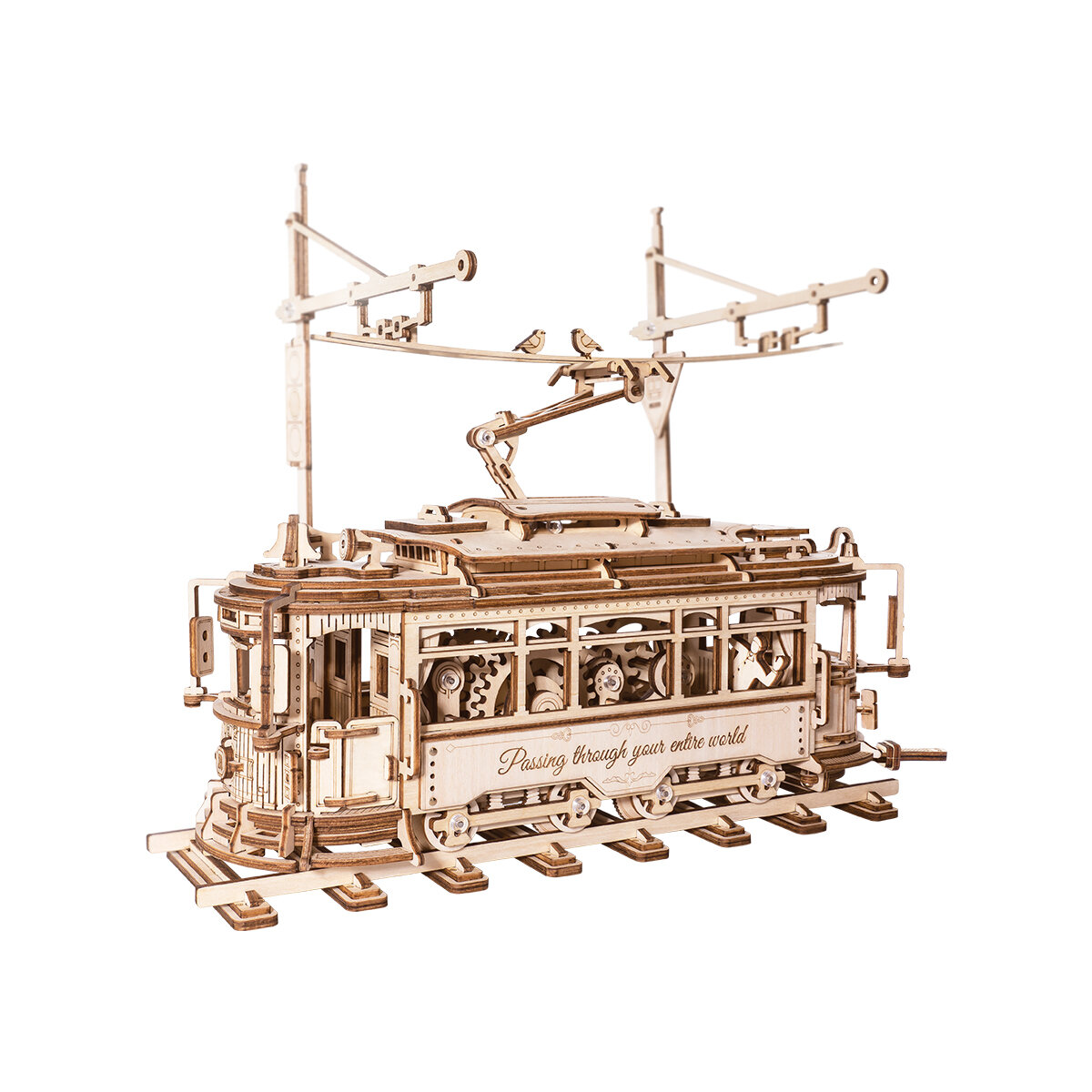
Wooden 3D puzzle - Classic city tram ROKR LK801
- Number of pieces: 374
- Assembly time: 5 h
- Difficulty: 3
Frequently asked questions
Where does a tram get its power from?
From the overhead line, a wire above the track that the current collector on the roof touches. The current returns through the wheels and the rails. In Bratislava, the line carries 600 volts of direct current.
Why does a tram not need a steering wheel?
The rails guide it. The wheels have a slightly conical running surface that keeps them in the centre of the track, and the flange on the inner side of the wheel stops it from slipping off the rail.
How does a tram brake?
Electrically, with the motors switched over to work as generators. It also has friction brakes on the wheels and, for rapid or emergency braking, a track brake whose electromagnets are pulled onto the rail.
When did trams start running in Bratislava?
The first tram with passengers took to the streets on 27 August 1895. The 550-volt current was then produced by a steam power station on today’s Pribinova Street.