







Sagrada Família has been growing since 1882 partly because, from the start, it was paid for by donations rather than state or diocesan funds, and work went only as fast as the money came in. Then war came in 1936, destroying some of Gaudí’s plans and models.
What sets it apart from a traditional cathedral is how it stands. Gaudí devised columns that branch like trees inside and support the vaults, so the building needs none of the external buttresses and flying buttresses familiar from Gothic cathedrals. It also differs in its windows, which control the light, and its three façades, each speaking a different language. At the end, you’ll see which of these features you can also spot on a wooden cathedral model, especially in the towers and façade details.
Contents of the article
Why is Sagrada Família taking so long to build?
Construction began with the crypt on 19 March 1882. The architect Francisco de Paula del Villar designed the church as a fairly conventional Gothic church, but stepped down in March 1883, when Antoni Gaudí took over. He changed the design from the ground up and devoted the rest of his life to it: from 1914 he took on no other commissions, and from November 1925 he lived in the workshop on the site itself.
Money was the second reason for the slow growth. The church was intended from the outset to be funded by donations, so the pace of work varied with how much people gave at any given time.
When Gaudí died in 1926 after being hit by a tram, less than a quarter of the building was complete, an estimated 15 to 25%. Of the eighteen planned towers, he lived to see just one finished: the bell tower of the apostle Barnabas on the Nativity façade.
Another turning point came in July 1936, when the crypt was set on fire during the Spanish Civil War and the workshop was broken into, destroying some of Gaudí’s plans and models. Work continued using the surviving material, reconstructed plans and photographs.
Only computers sped up the pace. In the 20th century, stone was carved by hand; today, it is shaped off-site on computer-controlled milling machines and assembled on site from finished panels.
The building’s highest point is now complete. On 20 February 2026, the central Tower of Jesus Christ reached a height of 172.5 metres, making Sagrada Família the tallest church in the world. The Glory façade on the south side, intended as the main entrance, remains unfinished, and according to the construction team’s announcement, work inside the tower will continue in 2027 and 2028.
A note on the name: Sagrada Família is often called a cathedral, but it is a basilica, consecrated by Pope Benedict XVI in 2010. Barcelona’s cathedral is a different, medieval church, the Cathedral of the Holy Cross and Saint Eulalia.
How does Sagrada Família differ from Gothic cathedrals?
Gaudí wanted to go beyond Gothic architecture, not repeat it. A Gothic cathedral supports its stone vault with external buttresses and flying buttresses, which, according to the building’s official guide, Gaudí considered unnecessary and unattractive, a kind of crutch.
Columns that branch like trees
A forest of columns inside carries the weight. Almost all are inclined and branch at several heights to support vaults, windows and roofs. The capital resembles a knot in a tree trunk, and from there the column divides into branches that disappear into the vault.
The column itself starts with a polygonal or star-shaped plan, which twists both right and left as it rises, gradually becoming a circle. This produces a shape that is more stable and looks slimmer.
Light instead of buttresses
When the walls do not bear the roof’s weight, they can have many windows. The colour of the glass follows the sun: the lower windows have the deepest colours, where visitors can read them, while the upper ones are clear so sunlight can illuminate the vaults and emphasise the height. In Gothic cathedrals, by contrast, the upper part of the windows is often the most colourful.
On the east side by the Nativity façade, the glass has cool shades of blue; on the west side by the Passion façade, it is red and orange, like evening light.
Three façades, three moods
The Nativity façade to the east is full of flowers, animals and rounded forms, and it was built during Gaudí’s lifetime. The Passion façade to the west was meant, in Gaudí’s brief, to be harsh and cruel, as though made of bones; Josep Maria Subirachs created its sculptures. The Glory façade to the south is not yet finished.
| What is compared | Gothic cathedral | Sagrada Família |
|---|---|---|
| What carries the weight of the vault | external buttresses and flying buttresses | branching columns inside |
| Where the glass is most colourful | often in the upper part of the windows | in the lower windows; the upper ones are clear |
What can you see on a wooden cathedral model?
A wooden church model reveals things that are easy to miss in a photograph. A Gothic cathedral model shows exactly what Gaudí replaced with his own solution in Barcelona.
- Towers. Count the towers on the model and compare their heights. Gaudí’s plan includes eighteen towers of different heights, so a model with two towers shows how far it differs from his plan.
- Flying buttresses. Look for arches that brace the nave from outside. If the model has them, you are seeing the supports Gaudí replaced with tree-like columns inside.
- Façade details. Look at where ornament is concentrated, for instance around the portal and rose window, and where the surface remains plain. Barcelona’s Nativity façade, by contrast, is full of detail from bottom to top.
You can find the stories of other famous structures in the articles on Tower Bridge and the Arc de Triomphe.
According to its catalogue description, the wooden model of a Paris cathedral ROWOOD TG511 has two towers, a slender spire, a rose window and flying buttresses.
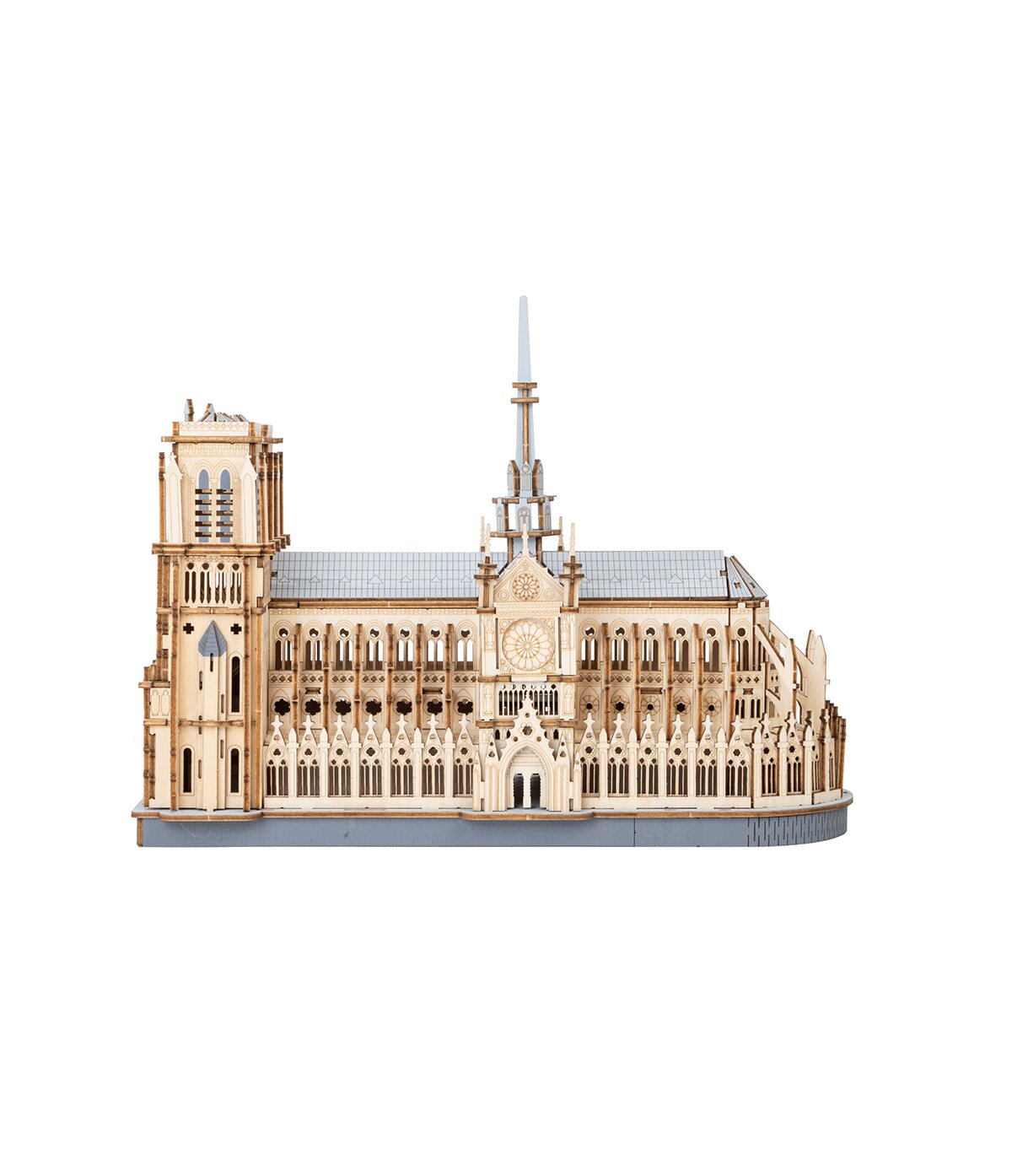
Wooden 3D puzzle - Paris Cathedral ROWOOD TG511
- Number of pieces: 330
- Assembly time: 2 h
- Difficulty: 2
Another option is Notre-Dame Cathedral Little Story E017. Both kits have a recommended age of 14 and over.

Wooden 3D puzzle - Notre-Dame Cathedral Little Story E017
- Number of pieces: 313
- Difficulty: 2
The article 3D puzzles for adults explains what makes a model challenging for adults.
Common questions
Is Sagrada Família a cathedral?
No, it is a basilica, consecrated by Pope Benedict XVI in 2010. Barcelona’s cathedral is the medieval Cathedral of the Holy Cross and Saint Eulalia.
When will Sagrada Família be finished?
There is no exact date. The outside of the tallest tower has been complete since 20 February 2026, but the Glory façade is not yet finished, and work inside the tower continues.
Why did Gaudí not use flying buttresses?
According to the building’s official guide, he considered them unnecessary and unattractive. He transferred the weight of the vaults to branching columns inside.