










Napoleon had the Arc de Triomphe in Paris built to honour his army after the victory at the Battle of Austerlitz in December 1805. The foundation stone was laid on 15 August 1806, Napoleon’s birthday, but changes of government interrupted the work, and the arch was not opened until July 1836, after 30 years.
It stands in the middle of a round square because it was built where roads already met in the shape of a star, and today twelve avenues radiate from it. On its walls you’ll find four large sculptural groups, six reliefs of battles and hundreds of names of battles and generals, and under the vault the tomb of an unknown soldier from the First World War. You can look for the same parts on a wooden model of the arch too.
Contents of the article
Why the arch was built and why it took 30 years
Napoleon wanted the arch to celebrate the Grande Armée, the army with which he had won at Austerlitz. The models were the ancient Roman triumphal arches, above all the Arch of Titus in Rome, and the design was prepared by the architect Jean-François Chalgrin.
The arch stands at the western end of the Champs-Élysées, facing the Tuileries Palace, which was then Napoleon’s residence in Paris. This makes it part of a long straight axis that runs from the Louvre along the Champs-Élysées and on to the west.
In 1810 Napoleon married Marie Louise of Austria, and the wedding procession was to enter Paris across the square where the arch was being built. The pillars barely rose above the ground at the time, so Chalgrin had a full-size arch built from a wooden frame and painted canvas. On this model he saw his design in place and adjusted it further.
Chalgrin died in 1811. After Napoleon’s fall in 1814 construction stopped, and it was only restarted by King Louis XVIII in 1823. It was completed under King Louis-Philippe, who dedicated the arch to the armies of the Revolution and the Empire. The arch was opened on 29 July 1836.
The arch is made up of four massive stone pillars joined by vaults. On the two main sides there is one large archway, on the narrower sides smaller ones. A spiral staircase runs inside a pillar, and it is 284 steps up to the roof of the arch.
The square around the arch was called Place de l’Étoile, the Square of the Star. Roads met here in the shape of a star even before the arch was built, but today’s twelve avenues were only created during the rebuilding of Paris led by Prefect Haussmann in the second half of the 19th century. Since 1970 the square has borne the name of Charles de Gaulle. The arch itself is about 50 metres high and about 45 metres wide.
What the sculptures, reliefs and names on the walls show
The decoration was created by several sculptors only in the 1830s, when the building was being completed. The largest pieces are the four sculptural groups on the pillars, and each of them belongs to one year:
- The Departure of the Volunteers of 1792 by François Rude, also known as “La Marseillaise”, on the side facing the Champs-Élysées. Above the volunteers, who are leaving to defend the young republic, hovers a winged woman, the Genius of Liberty.
- The Triumph of 1810 by Jean-Pierre Cortot, also on the side facing the Champs-Élysées. It celebrates Napoleon’s victories.
- The Resistance of 1814 and The Peace of 1815 by Antoine Étex on the opposite side of the arch.
Above the sculptural groups are six reliefs, pictures carved into the wall so that the figures stand out from it. They show events of the Revolutionary and Napoleonic Wars, among them the Battle of Austerlitz. Higher up, a frieze, a band with a relief of soldiers, runs around the arch, and at the very top is the attic, the upper part of the building above the cornice. On the attic there are 30 shields with the names of victorious battles.
Carved on the inner walls of the archways are the names of battles and of hundreds of generals from the wars of the Revolution and the Empire. When a name is underlined, that man fell in battle. The ceiling of the great vault is decorated with carved rosettes.
What the Tomb of the Unknown Soldier under the arch is
Under the great vault lies a French soldier from the First World War whose name nobody knows. He stands for all who fell for France in the war. The idea of honouring the fallen through one unknown soldier arose as early as 1916, during the war.
On 10 November 1920 in Verdun, the soldier Auguste Thin chose one of eight coffins holding the bodies of unidentified French soldiers. The next day it was taken to the Arc de Triomphe, and on 28 January 1921 the soldier was buried in the place where he lies to this day. The slab of the tomb bears an inscription in French which reads in translation: “Here lies a French soldier who died for his country, 1914–1918”.
The flame over the tomb was first lit on 11 November 1923 by the Minister of War, André Maginot. Since then it has been rekindled every evening at 6.30 pm in a ceremony organised by the association La Flamme sous l’Arc de Triomphe. Today the flame commemorates the dead of both world wars.
What to notice on a wooden model of the Arc de Triomphe
A wooden model shows the arch in miniature, so you can compare it with the real building. Chalgrin also checked his design on a model, although a full-size one. Which parts of the decoration your model has and how it renders them, you’ll find out from its instructions and pictures. When comparing, focus on these places:
- The ratio of height to width. The real arch is about 50 metres high and about 45 metres wide, so almost as wide as it is high. Measure the height and width of the model without its base. If the ratio comes out clearly different, the model has adjusted the building in this respect.
- The sculptural groups by the pillars. On the two main sides, look for four sculptural groups at the foot of the pillars. On the real arch, the Departure of the Volunteers and the Triumph are on the side facing the Champs-Élysées, so they tell you which side of your model would face this avenue.
- The surfaces above the sculptural groups. On the real arch there are reliefs of battles there. Compare what is in the same place on the model: a picture, a pattern or a plain surface.
- The upper part. Above the archway, find the cornice, the band of the frieze and the attic. On the real arch the attic carries 30 shields with the names of battles, so look at how your model renders it.
If you want to look at these parts up close at home, the wooden model Arc de Triomphe Little Story E011 is, according to the shop’s details, intended for ages 14 and up.
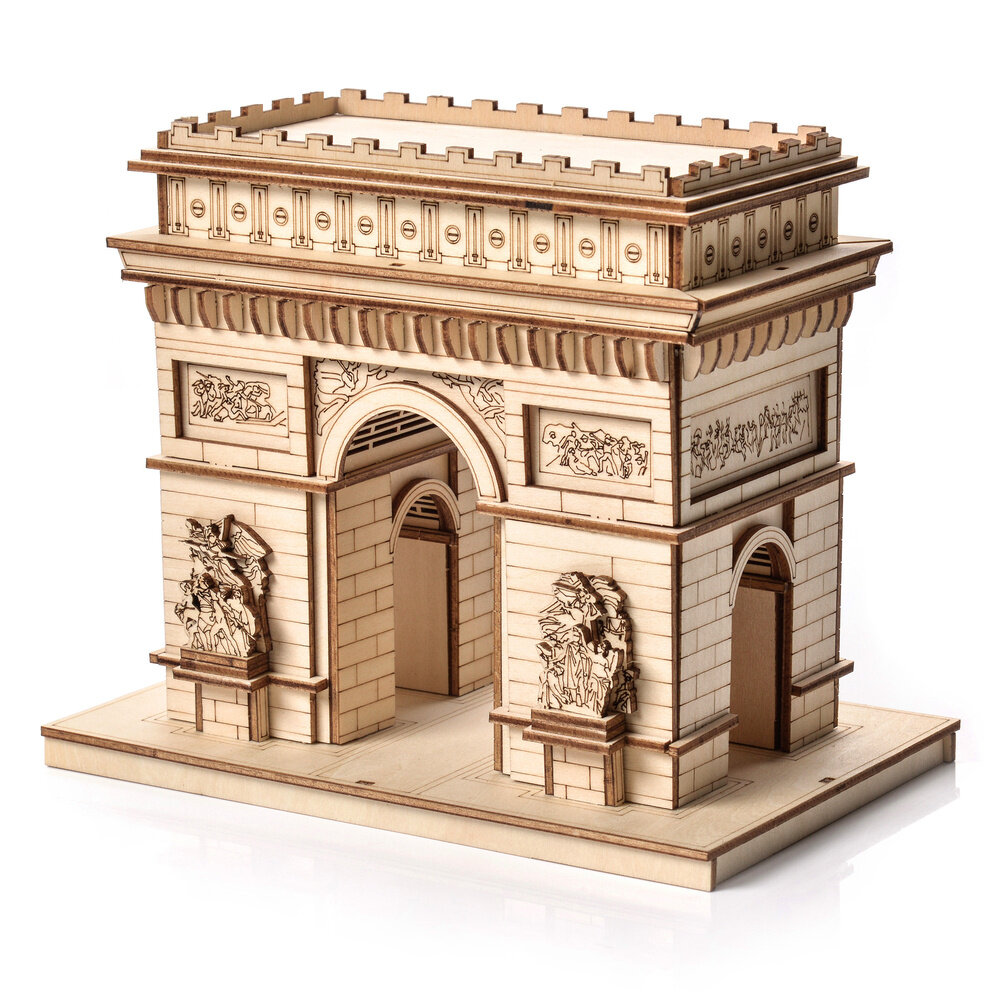
Wooden 3D puzzle - Arc de Triomphe Little Story E011
- Number of pieces: 164
- Difficulty: 1
Frequently asked questions
Who had the Arc de Triomphe built?
Napoleon, to honour his army after the victory at Austerlitz in 1805. The foundation stone was laid in 1806, and the arch was opened in 1836, during the reign of King Louis-Philippe.
Why did the Arc de Triomphe take 30 years to build?
Changes of government interrupted the work. It stopped after Napoleon’s fall in 1814, Louis XVIII resumed it in 1823, and it was completed under Louis-Philippe.
Why does a flame burn under the Arc de Triomphe?
It burns over the tomb of an unknown soldier from the First World War. It was first lit on 11 November 1923, and since then it has been rekindled every evening at 6.30 pm in a ceremony.
What do the underlined names on the walls of the arch mean?
The inner walls carry the names of battles and generals from the wars of the Revolution and the Empire. An underlined name belongs to a man who fell in battle.