
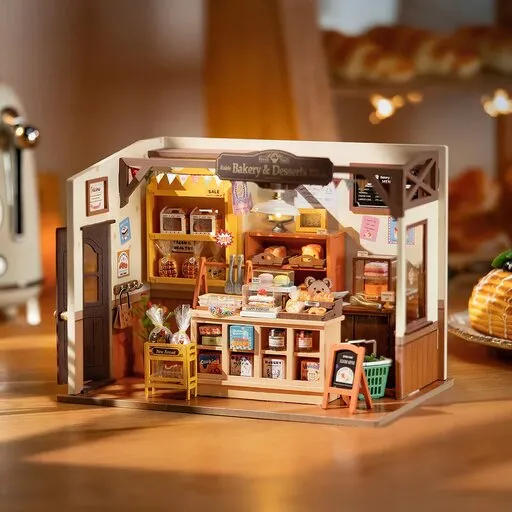
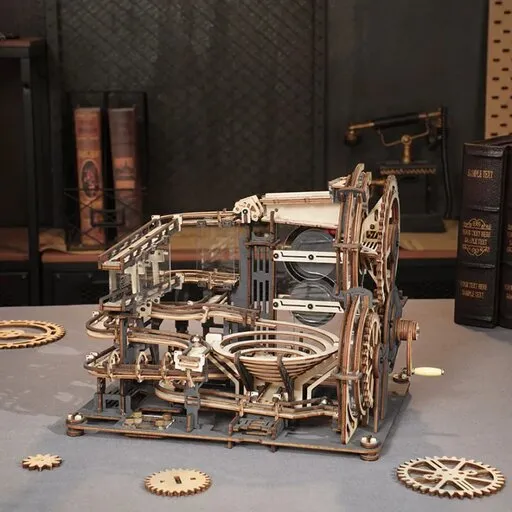

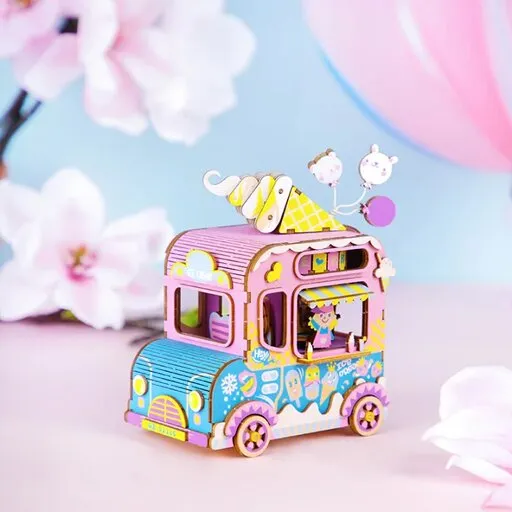

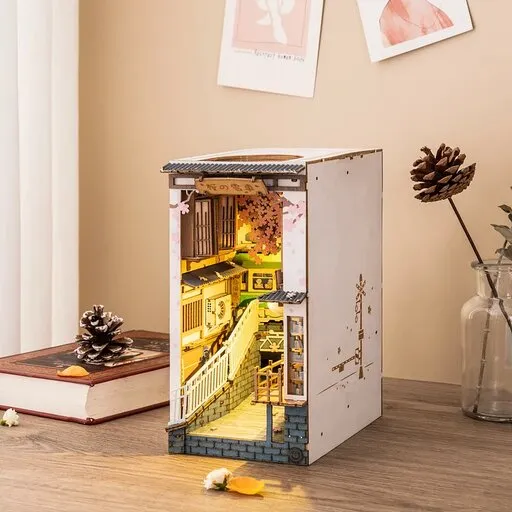







The difficulty of a wooden 3D puzzle is not set by the number of pieces alone. It matters just as much whether the model has a mechanism, meaning parts that move once it is built, and how small and thin its pieces are. A model with 250 pieces that just stands on a shelf builds differently from a model with the same number of pieces in which gear wheels have to mesh with each other.
Before you choose, compare four things for a model: the number of pieces, the stated assembly time, the difficulty number and whether the finished model moves. If you have never built a wooden model, start with a lower difficulty and no mechanism. If you already have a static model behind you, add just one new challenge next time, not all of them at once.
Contents of the article
What makes a wooden model challenging
With a wooden 3D puzzle, difficulty is made up of several things at once. None of them decides on its own, but each one adds work, attention or time.
- Number of pieces. More pieces mean more steps and a longer build. Repeating pieces, for example identical windows or railings, raise the count without making the build much more complex.
- Mechanism. Gear wheels, axles, a crank or a spring must sit precisely so that the motion is passed on. A small deviation at the start may only show up several steps later as rubbing or sticking.
- Small and thin pieces. Narrow bridges, thin teeth and small pegs bend or crack more easily when you press them out and push them in. You need more light, a steady hand and must not push with force.
- Fit of the joints. The fit means how tightly a piece sits in its slot. A tight joint holds firmly but needs straight, even pressure; with a loose joint you have to watch that the piece does not fall out.
- Order of steps. With curved and layered shapes, pieces must go into the model in an exact order, and you can only fix a mistake from an earlier step by going back.
So a mechanical model is not more challenging just because it has more pieces. It is more challenging because it has to work at the end, which a static model never has to do. The kinds of wooden models and how they differ are described in the article Kinds of wooden 3D puzzles: which one suits you.
How to judge difficulty and time before choosing
You can judge the difficulty before choosing if you read the details of a model together, not one by one. The table shows what raises the difficulty, where you can find it for a model and what it will mean while building.
| What raises the difficulty | Where you find it | What it means while building |
|---|---|---|
| more pieces | the number of pieces in the model details | more steps and more evenings |
| mechanism | description and photos: gear wheels, crank, spring, moving parts | testing the motion while building and fine-tuning at the end |
| small and thin pieces | photos of the pieces and details of the finished model | careful pressing out, more light, a slower pace |
| longer assembly time | the assembly time in the model details | the build split over several sittings |
| higher difficulty number | the difficulty in the model details | more steps where you have to be precise |
- Compare the number of pieces with the assembly time. Two models with a similar number of pieces and different times differ in how complex the pieces are. A longer time at the same piece count suggests a mechanism or fine work.
- Look at the difficulty number. A higher number means a more challenging model. Compare it between models in the same shop.
- Read in the description what moves. If the description mentions gear wheels, a crank, a spring or moving parts, it is a mechanical model. Expect to test and fine-tune the motion while building.
- Look through the detail photos. Look for thin railings, small wheels and fine decorations. The more of them you see, the more slow work awaits you.
- Take the assembly time as a guide. The stated time applies to a smooth build. For your first mechanical model, allow extra time and split the build over several evenings.
If these points give you one new challenge, for example your first mechanism at a piece count you already know, it is a sensible step forward. If they give you three at once, the model will probably test you more than you want.
How models for adults differ from children’s models
Models meant for younger children, for example from 5 years, mostly have a few dozen pieces and an assembly time of up to one hour. Models from 14 years mostly have hundreds of pieces, finer details, more often a mechanism too, and an assembly time of usually several hours. How to choose the difficulty for a child is described in the article First 3D puzzle for a child: how to choose the difficulty.
The recommended age, for example from 14 years, says from what age the model is suitable, not that it is meant only for adults. For an adult the age is only the lower limit; whether you will enjoy the model depends more on the difficulty, the mechanism and the time you want to give it. If you build with older children, keep to the model’s recommended age.
How to tell a model is too easy or too hard for you
A well-chosen model makes you think, but does not stop you for whole evenings. From how the build goes you can tell which way to move next time.
- The model is too easy when you finish it in one sitting, you do not need to read the steps in the manual ahead and you do not have to test or fine-tune anything on it. Next time choose a model with a mechanism or a higher difficulty number.
- The model is right when you occasionally go back a step, find after checking what was turned the wrong way and the mechanism runs after a small adjustment. With the next model you can stay at the same difficulty or go one level higher.
- The model is too hard when a piece repeatedly refuses to go into its slot and you feel like pushing with force, when thin pieces break or when the mechanism does not run even after several attempts. Next time choose a model one level lower or without a mechanism.
When a model is hard, you do not have to give up. Put it aside until you have had a rest, then go back one or two steps in the manual and check whether the pieces face the same way as in the picture. A piece fitted the wrong way round is a common reason why the next piece does not fit.
If the mechanism rubs or sticks, do not add force. How to find the point of friction is described in the article Sticking mechanism: how to find the friction and fix it.
Tip: With a mechanical model, turn each group of gear wheels as soon as you have built it, before you cover it with more pieces. If it runs smoothly, carry on; if it rubs, fixing it now is easier than at the end.
The build has worked when all pieces sit straight, nothing sticks out and whatever should move runs without catching. If you felt you had to make an effort but did not have to fight, you chose a difficulty that suits you.
Similar piece count, different difficulty: four examples
If you want to see how difficulty changes at a similar piece count, here are four models with 247 to 308 pieces. The piece count, assembly time and difficulty come from the shop data; allow some extra time for your first build.
Wooden 3D puzzle - London tourist bus Rolife TGM02 is a static model without a mechanism, with difficulty 2. Wooden mechanical 3D puzzle - Racing car ROKR LK505 has working mechanical parts with gear wheels and difficulty 3. Wooden 3D puzzle - Prime steam express train ROKR MC501 has a moving piston and flywheel and runs by itself once the spring is wound. Wooden mechanical 3D puzzle - Classic printer ROKR LK602 has a mechanism driven by a handle and, with it, the longest assembly time of these four.

Wooden 3D puzzle - London tourist bus Rolife TGM02
- Number of pieces: 255
- Assembly time: 3 h
- Difficulty: 2

Wooden mechanical 3D puzzle - Racing car ROKR LK505
- Number of pieces: 247
- Assembly time: 4 h
- Difficulty: 3

Wooden 3D puzzle - Prime steam express train ROKR MC501
- Number of pieces: 308
- Assembly time: 4 h
- Difficulty: 4

Wooden mechanical 3D puzzle - Classic printer ROKR LK602
- Number of pieces: 303
- Assembly time: 5 h
- Difficulty: 4
Frequently asked questions
Is a wooden 3D puzzle suitable for adults?
Yes, many models are designed for older children and adults: they have hundreds of pieces, small details and often a mechanism. The recommended age, for example from 14 years, is the lower limit, not the upper one.
How many pieces should an adult’s first model have?
There is no fixed number, because it also depends on the mechanism and small pieces. If you are building for the first time, choose a model with a lower difficulty and no mechanism; compare the number of pieces with the stated assembly time.
Is a mechanical model harder than a static one?
At a similar number of pieces usually yes, because the mechanism has to work at the end. Gear wheels and axles must be fitted precisely and the motion tested while building.
What should I do when a model is too hard for me?
Put it aside and come back to it rested. Go back a step or two in the manual and check whether the pieces face the same way as in the picture. Do not push a piece with force; with a mechanism, look for the point where it rubs.