
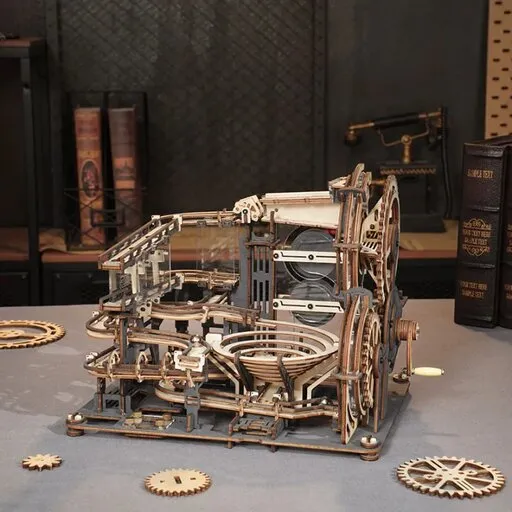











On a wooden run, the marble most often stops at a joint between two parts that does not line up exactly, at a part fitted the wrong way round, or at a spot where friction slows it or another part touches it. It usually falls out when it reaches a curve too fast, or when a gap is left in the track by a part that is not pushed in all the way.
So the first step is the same on every run: take out all the marbles except one and release it slowly, always from the same spot. Watch exactly where it slows down, stops or bounces off. Then compare that one spot with the manual before you start taking a bigger section of the model apart.
Contents of the article
Where the marble stops or falls out and why
The cause shows at the spot where the marble behaves differently. When you test with one marble, notice what it does just before it stops or falls out:
- It stops at a joint between two parts. Run your finger over the joint. If you feel a step or one part sticks out, the joint is not level and a slow marble catches on it. Check that both parts are pushed in all the way.
- It slows down and stops on a straight section. The section has less slope than the marble needs, or friction slows it. Compare it with the picture in the manual and check that the parts and supports of this section are pushed in all the way. If they are, look for a spot where the marble rubs against something.
- It stops in a curve or a narrow spot. Check whether a neighbouring part, a decoration or a support touches the track and whether the track board itself has bent. Pressure from the surrounding parts can narrow the track so much that the marble cannot pass.
- It stops in an opening or in a switch. A switch is a moving part that sends the marbles to two sides in turn. Check that it is not turned the wrong way round and that the bushings on its axle are not pushed in too far. A bushing is a small ring that holds the axle in place. When it is pushed in too deep, it clamps the moving part and the marble gets stuck in it. If everything is turned and pushed in correctly, the opening may be tight for the marble.
- It falls out in a curve. It reached the curve faster than the wall can hold it and went out over the outer side. Look at what comes before the curve: a marble keeps speeding up on a slope, so a section that works at the top can fail in the lower part of the run. The cause can also be a curve that does not line up exactly with the previous part.
- It falls out at a joint, at a wheel or at a disc. A gap or a step was left between the parts, for example because a part is not pushed in all the way. A slow marble gets over a small step, a fast one jumps off it.
- Sometimes it gets through and sometimes it does not. A part shifts as the marble passes, or you do not release the marble the same way every time. First release it always from one spot, then watch what moves as it passes.
When testing, change only one thing at a time and release the marble again after each change. If you adjust three spots at once and the run starts working, you do not know which adjustment helped. If it does not, you do not know which one made it worse.
How to check the slope, joints and curves
On a kit, the slope and the shape of the curves are set by the manual, so you do not rebuild the run. You fix the spots where the model has drifted from the manual. Work from the steps that can be undone to the ones that cannot:
- Put the model on a flat, firm surface. Stand it on a table, not on a carpet, a bed or a bent board. A soft or uneven surface can slightly warp the wooden frame and the track joints with it. If on the table the marble gets past the spot where it used to stop, the surface was the cause.
- Compare the problem spot with the manual. Check that every part is turned as in the picture, including front and back, and that none is missing. A part turned the wrong way round or left out can block the marble’s path.
- Press home the parts that do not sit right. Press them evenly from both sides, not one side first. If a part does not go any further, do not use force. Something is in its way, for example a neighbouring part that is not pushed in all the way either.
- Take the pressure off the track. If another part or a decoration touches the track, seat it exactly as in the manual so that it does not get in the marble’s way. The bushings on the axles should sit flush with the end of the axle, not be pushed in deeper.
- At a curve the marble falls out of, check how it connects. The curve must line up exactly with the previous part, and its outer wall must not be bent or broken off. If everything matches the manual, check that the model stands level. On a tilted model the slope of the sections changes and the marble can reach the curve faster.
- Sand only at the very end. If the part sits correctly and the marble still rubs against an edge or does not pass through an opening, sand exactly that spot with fine sandpaper, a little at a time. After each sanding, remove the dust and try the marble again. You cannot put sanded-off wood back, so this step does not come first.
- Replace a bent or broken part. If the track board is visibly bent and the marble does not get over it even after the pressure is released, do not force it. Ask the manufacturer for a spare part and give its number from the manual.
Wax goes only on the spots the manual marks, usually the teeth of the gears and the surfaces that rub against each other. Apply it thinly and turn the moving part several times to spread it. Too much wax slows the marbles down. Keep the track the marble rolls on dry and free of dust; a soft brush or a dry cloth is enough for the dust.
If a part broke while you were adjusting it, you will find how to glue and reinforce it in the article Cracked wooden part: how to fix it and keep building.
How to fine-tune the lift that carries the marbles up
The lift is the mechanism that carries the marbles from the bottom of the run back to the top so that they can go again. On wooden runs it is driven by a crank you turn by hand or by a small electric motor, and some runs have both. When it jams, proceed like this:
- Stop turning at once or switch off the motor. A crank that suddenly turns hard means something is blocking the movement, for example a stuck marble or a part. If you keep turning with force, you can break a wooden part. On a motorised lift, disconnect the power and take out the marbles before you reach into the mechanism.
- Check that the gears mesh. Turn the crank slowly and watch where the resistance comes from. If a panel is not pressed in all the way or an axle stands at an angle, the gears do not mesh cleanly and you feel it as resistance in the crank. The axle should be straight and turn freely before you fit the gears on it.
- Check the direction and completeness of the lift parts. Compare with the manual whether any gear or guide part is turned the wrong way round and whether any is missing. If the marbles fall out of the lift while you turn, a part that should hold and guide them is missing or sits wrong.
- Wipe the marbles. Dirt on the marbles can slow the lift. Wipe them with a dry cloth and try again.
- Only then apply wax. If everything sits right and the lift still turns hard, wax the spots where the gears mesh, as the manual marks them.
If it is the gears rather than the marble that get stuck, you will find a detailed way to track down friction in the article Sticking mechanism: how to find the friction and fix it.
On the Marble Night City ROKR LGA01 model you carry the marbles up by turning a crank, so you feel any resistance in the mechanism directly in the crank. According to the shop description, the Marble track London ROKR EGB01 has a small electric motor powered through a USB-C connector (5 V, 1 A), and the cable is not included in the box. The description of the Marble track London ROKR EGB01 model also points out that the box may not contain wax and that a candle, beeswax or a child’s crayon can replace it. According to the shop data, both the Marble Night City ROKR LGA01 and the Marble track London ROKR EGB01 are intended for ages 14 and up.
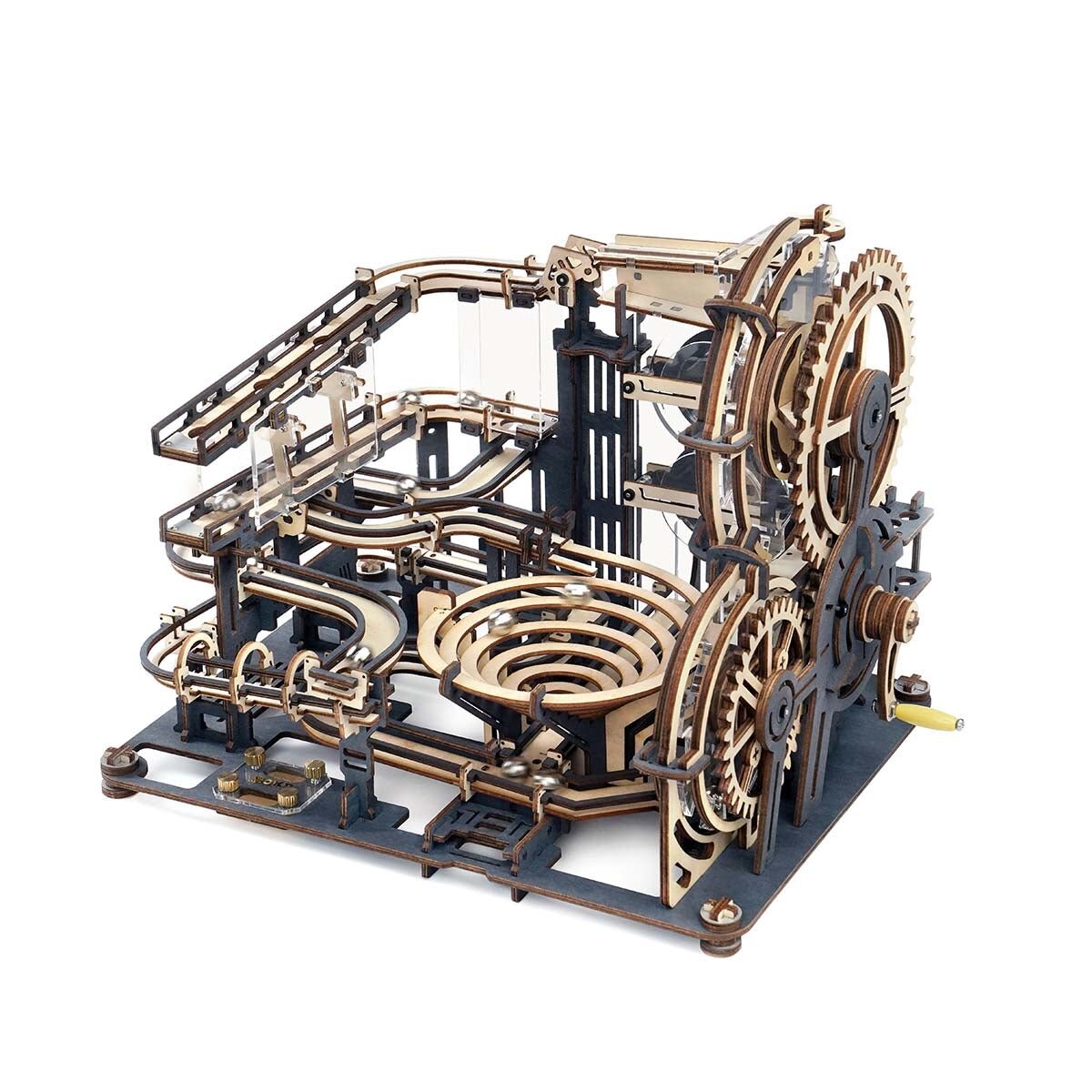
Wooden 3D puzzle - Marble Night City ROKR LGA01
- Number of pieces: 294
- Assembly time: 7 h
- Difficulty: 4
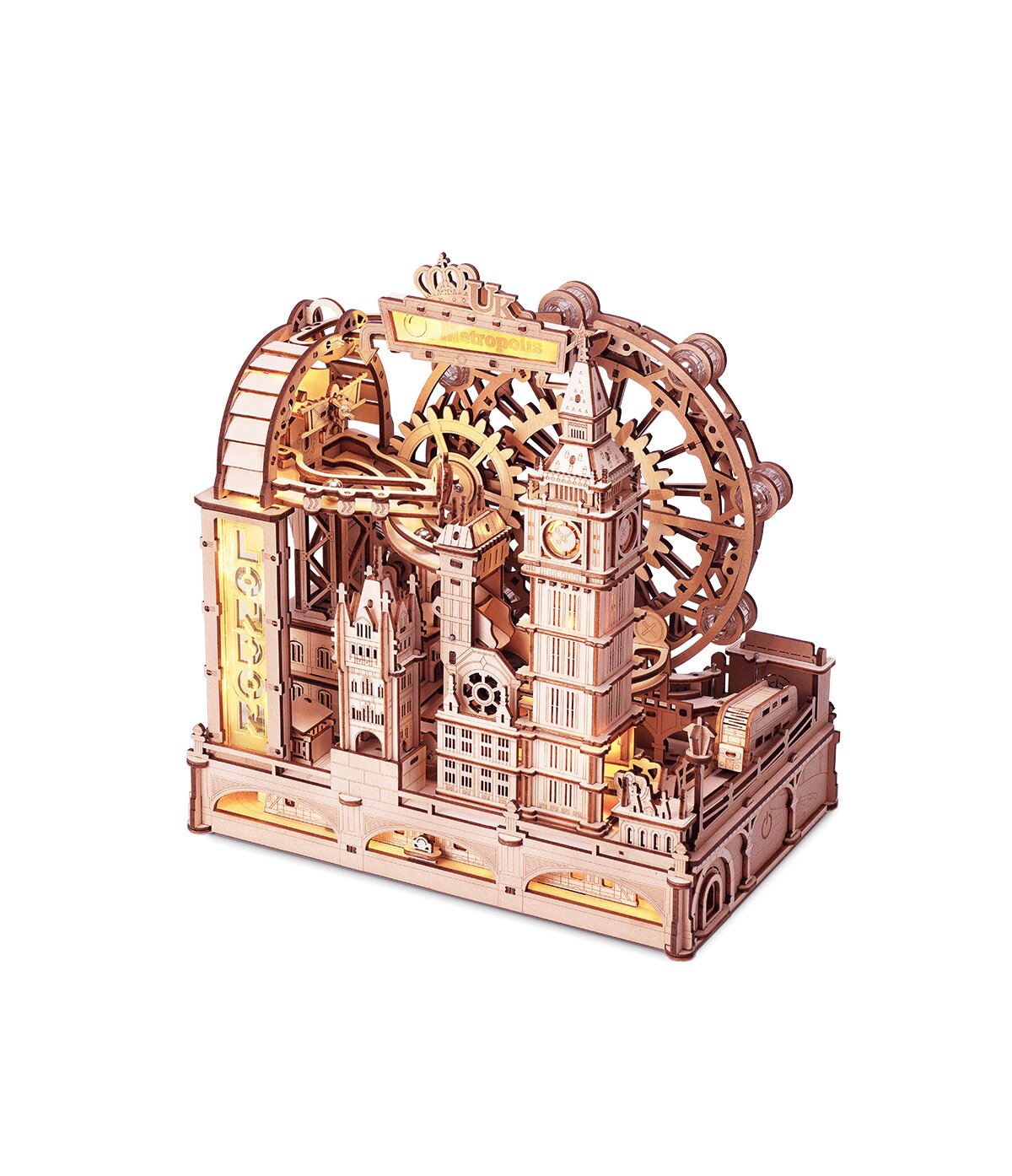
Wooden mechanical 3D puzzle - Marble track London ROKR EGB01
- Number of pieces: 431
- Assembly time: 5 h
- Difficulty: 4
How to check that the run keeps going without your help
The run is finished when the marbles go round the whole circuit again and again and you do not have to step in. Check it step by step:
- One marble, several laps. Release one marble and let it go round the whole circuit several times in a row. If it passes every spot the same way each time, the joints and curves are fine.
- Add marbles one at a time. Only then add another marble and watch whether they collide or stop anywhere. If they keep stopping at one spot, go back to it and check it as in the previous section.
- Watch the crank or the motor. On a correctly built lift, the crank turns smoothly and the lift rises evenly, without clicking or skipping. Clicking or jerky movement means that a gear does not mesh cleanly.
- Check that nothing shifts. After a few minutes of running, look at the spots you fixed. A part that shifted as the marbles passed can go back to the wrong position, and the problem with it.
If the marble still does not get through after these steps, take a photo or a video of the spot where it stops and send it to the manufacturer with the name of the model. A clear photo or a short video shows whether it is an uneven joint, the slope, friction or a part pushed in too tightly.
Frequently asked questions
Why does the marble keep falling out at the same curve?
Most often it reaches it too fast, or the curve does not line up exactly with the previous part. Check the joint before the curve, its outer wall and whether the model stands level.
Can I wax the track so the marbles go faster?
No. Wax goes only on the spots the manual marks, for example the teeth of the gears. Too much wax slows the marbles down, and the track should stay dry and free of dust.
What do I do when the crank suddenly will not turn?
Stop turning and find what is blocking the movement. It may be a marble stuck in the lift or a part that is not pushed in all the way. With force you can break a wooden part.
When should I sand a part?
Only when it is turned and pushed in exactly as in the manual and the marble still rubs against it. Sand only that one spot, a little at a time, and try the marble again after each sanding.