










In pinball, a spring launches the ball. When you pull back the plunger knob, you compress a spring behind a rod. When you let go of the knob, the spring flings the rod forward and it sends the ball up a narrow lane to the top end of the playfield. The further you pull the knob, the more you compress the spring and the harder the ball flies out.
The slope brings it back down. The playfield is not level: it rises away from the player, on today’s machines usually by 6.5 degrees. Gravity therefore keeps pulling the ball towards the bottom edge, where a gap waits between two flippers. The flippers are short levers that you control with buttons on the sides of the cabinet and use to knock the ball back up. When the ball gets past them, it drops through the gap and leaves play.
In this article
How the plunger and the slope control the ball
The plunger is a spring-loaded rod with a small knob on the front of the cabinet. You control the force of the launch by how far you pull the knob, that is, how much you compress the spring. On many machines there is a target near the top edge that has to be hit straight from the launch, and then even a little more or less pull on the knob makes the difference. Once the ball is in play, you no longer need the plunger until the next ball. Some newer machines have a button instead that launches the ball electrically.
The slope is set by whoever operates the machine, using screw-in legs under the cabinet. Manufacturers recommend about 6.5 degrees away from the player, and from side to side the playfield should be level. With a steeper slope the ball comes back down faster and the game is harder; with a gentler one it is slower. The slope works against the plunger: the spring sends the ball up and gravity brings it back down. Montague Redgrave described exactly this principle back in 1871 in his patent for a tabletop game with a spring plunger.
Players also help themselves by gently nudging the cabinet to push the ball a little. Against excessive shaking the machine has a tilt, a safeguard against tilting and shaking. In it, a cone-shaped weight hangs inside a metal ring, and when you shake the cabinet too much, the weight touches the ring and closes an electrical circuit. The machine then switches off the flippers and other features, and the ball rolls straight into the gap at the bottom.
How flippers, bumpers and rubber slingshots work
Both the flippers and the bumpers are driven by an electromagnet, which in pinball is called a coil. It is wire wound around a hollow core in which a metal core can slide. When current flows through the coil, a magnetic field forms and pulls the core in. The core is connected to a part on the playfield, so its movement turns into a flipper or bumper strike. When the current stops, a spring returns the core and the part.
A flipper is a lever roughly 3 to 7 centimetres long. With the button on the side of the cabinet you close a switch, current flows through the coil under the playfield, and its core turns the flipper upwards through a linkage. The flipper coil has two windings, and each does a different job:
- Strong winding. It gives the flipper a sharp kick at the start of the movement. Current flows through it only briefly; if it stayed on longer, the coil would overheat.
- Weak winding. When the flipper reaches its upper position, a small switch underneath it, called the end-of-stroke switch, switches the coil to the weak winding. This only holds the flipper up while you hold the button, and it heats up much less. Newer machines make this switch electronically, based on time.
- Spring. When you release the button, the current stops and a spring returns the flipper down.
Thanks to the weak winding, you can stop and hold the ball on a raised flipper and then calmly choose where to send it. You influence the direction and speed of the shot by when you press the button, because the flipper hits the ball at a different point and at a different angle.
A bumper, in pinball called a pop bumper, is a round post with a plastic skirt near the playfield and a metal ring above it. The skirt hangs a few millimetres above the playfield. When the ball rolls over its edge and presses it down, a pin under the skirt closes a switch, which turns on the coil. The coil pulls the metal ring sharply down and the ring pushes the ball away. This happens in a fraction of a second, so it looks as if the ball simply bounced off the bumper on its own.
Above the flippers, on both sides, stand two triangular bumpers wrapped in rubber, called slingshots. Behind the rubber there are switches. When the ball hits the rubber, a switch turns on the coil and a small arm behind the rubber kicks the ball diagonally upwards, towards the other side of the playfield. Older passive bumpers do not kick the ball; they only bounce it back like a fixed obstacle.
A switch registers every hit and the machine adds points. Old machines did this with relays and rotating number reels; since the 1970s chips and displays have done it.
How pinball grew out of tabletop bagatelle
The ancestor of pinball is bagatelle, a tabletop game whose origin is attributed to France. It was played on a slightly tilted wooden table with holes at the far end. The player sent balls with a cue, and pins fixed to the board bounced them into scoring holes. Pinball later got its name from these pins.
The decisive change came from Montague Redgrave, an Englishman who had settled in Cincinnati in the United States. In 1871 he was granted a patent for a bagatelle in which a spring plunger, like the one pinball machines still have today, launches the ball instead of a cue. His tables were smaller, had bells that rang on a hit, and used coloured glass marbles.
In the 1930s bagatelle became a coin-operated machine. The first big successes came in 1931 and 1932: small countertop machines with the playfield under glass, fully mechanical and without flippers. After the launch, the ball simply fell between the pins until it dropped into one of the holes. The player could influence it only with the force of the launch and a nudge to the cabinet.
Electricity came to pinball in 1933. The first electrical feature was a coil that kicked the ball out of a hole back into play. The tilt appeared in the same year. At first it was a small ball on a pedestal that fell off when the machine was shaken, and a little later it was replaced by a weight in a ring, as machines still have today.
Flippers driven by an electromagnet arrived in 1947. Some machines had hand-operated mechanical levers even before that, but only electric flippers kept the ball in play much longer. The first machine with electromagnetic flippers had six of them, spread across the whole playfield, because they were weak and could not get the ball from the bottom edge all the way to the top. A year later a machine appeared with only two flippers at the bottom edge, and by the early 1950s a pair of flippers above the gap at the bottom had become standard. In many languages the whole machine is named after the flippers and is called a flipper.
In the 1970s microprocessors and digital displays replaced relays and mechanical score counters. The principle of the game, however, has not changed: a spring or a button launches the ball, the slope brings it back down, and the flippers and bumpers send it back up.
What of pinball you can find on wooden mechanical models
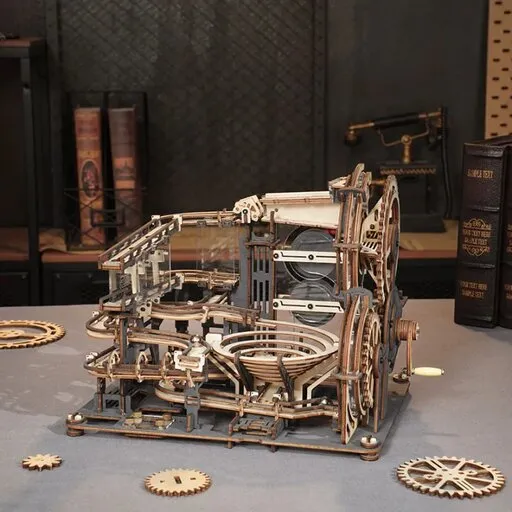
Pinball rests on three simple things: a spring that stores force, a lever that changes the direction and length of a movement, and a sloped surface on which the ball rolls by itself. You can find the same principles on wooden mechanical models too. Which of them your model uses, you will find out from the manual and the pictures, because every model is built differently. When you look it over, focus on these spots:
- Spring or rubber band. See whether the model drives something with stored force, such as a compressed spring or a stretched rubber band, much like the pinball plunger. The more you compress or stretch it, the more force it stores and the more sharply the movement starts. How far to tension it is given in the manual; stick to it.
- The lever and its pivot. Find the point around which the lever turns. When you push the lever close to the pivot, a short movement turns into a longer and faster one at its far end, but you need more force for it. Check whether the lever moves freely and returns to its starting position. If it drags, you will find how to track down friction in the article Sticking mechanism: how to find the friction and fix it.
- The slope of the track. On a marble run the slope does the same as the pinball playfield: gravity pulls the marble down, a steeper section speeds it up and a gentler one slows it down. The slope is set by the manual, so you do not change it; you only check that the parts sit the way the manual shows. When the marble stops or falls out on the track, the article Marble run: why the marble stops or falls out will help you.
On a real machine you will notice all of this without taking anything apart. After the launch, the ball slows down the higher it climbs, and near the top edge it turns back down. A bumper pushes it away the moment it rolls over its skirt. And when you hold a flipper button, the flipper stays up, so you can stop the ball on it and choose the next direction.
Frequently asked questions
What launches the ball in pinball?
A spring in the plunger. When you pull the knob, the spring is compressed, and when you let go, the rod flings the ball onto the playfield. Some newer machines have a button instead that launches the ball electrically.
Why does the ball always come back down?
The playfield rises away from the player, usually by 6.5 degrees, and gravity pulls the ball towards the bottom edge. The flippers knock it back up, and when the ball gets past them, it leaves play through the gap between them.
How does a flipper move when you press the button?
The button turns on the coil, an electromagnet under the playfield, which turns the flipper upwards through a linkage. The strong winding gives the kick, the weak one holds the flipper up while you hold the button, and after you let go a spring returns it.
Since when has pinball had electric flippers?
Since 1947. Before that, some machines had only mechanical levers, and on many the ball simply fell between the pins into holes. The first machine with electric flippers had six; a pair of flippers at the bottom edge became established in the early 1950s.