











A record player plays music by a needle following the spiral groove on a record, and the groove’s tiny waves make the needle vibrate. The vibrations then turn into sound: in an old gramophone through a thin diaphragm and a horn, in a modern player through a magnet and a coil into an electrical signal that an amplifier strengthens.
On a record player model you will see it in three parts: the platter, the tonearm with the needle, and the gearing, that is, the gear wheels that turn the platter. Even turning helps the tone keep its pitch, and the friction of the needle in the groove gradually wears out both the record and the needle.
Contents of the article
How the movement of the needle in the groove turns into sound
Sound is stored on a record as the shape of the groove. A machine cuts the record by engraving the movement of the sound into the groove wall, and playback goes the opposite way: the needle (technically the stylus) rides along the groove wall and vibrates according to its waves. The tonearm that the needle sits on moves slowly across the record because the groove guides it.
An old gramophone needs no electricity. The needle is connected to a thin diaphragm in the soundbox. The diaphragm vibrates together with the needle, sets the air in the tonearm moving, and the air continues into the horn, which passes the sound on to the room. The horn gradually widens away from the tonearm, which helps carry the sound from a narrow tube into a large space.
A modern player turns the vibrations into electricity. The needle sits on a thin rod that, inside the cartridge, moves a magnet between coils, or coils in the field of a magnet. The movement induces a small electrical voltage in the coil that corresponds to the shape of the groove. An amplifier strengthens it, and a loudspeaker turns it back into sound.
The shape of the groove differs by era. Berliner’s flat discs have a groove in which the needle swings from side to side, whereas Edison’s cylinders had a groove with an up-and-down movement. Stereo records have groove walls tilted by 45 degrees, and each wall carries one channel, left or right.
Why the platter should turn evenly
The needle follows the shape of the groove, but the tone also depends on how fast the groove passes under the needle. That is why records have a set speed: 33⅓, 45 or 78 revolutions per minute. If you set the wrong one, it will not damage the record, but the music will play too fast or too slow, so check the speed on the record before playing.
The speed must also be even. If it fluctuates, the pitch fluctuates too: a slow fluctuation sounds like a wavering tone, and in the extreme case the music sounds as if it were drunk.
Even turning is not a given. On a loud passage the groove slightly brakes the platter, especially with simpler drives. A heavy platter behaves like a flywheel: its speed changes slowly and not abruptly, which is why some players use one.
An old gramophone solves this mechanically. The first machines required someone to turn a crank the whole time. Later, a spring was wound once with the crank, gear wheels passed its energy to the platter, and a centrifugal governor, typically three weights on springs, kept the speed stable.
Why records and the needle wear out
During playback the needle rubs against the groove walls, and the friction wears out both the record and the tip of the needle. Fine dust that gets between them behaves like a fine abrasive powder.
A worn needle harms the record too: flat spots with sharp edges form on the tip and can damage the groove. A higher tracking force wears the record faster, so set the force according to the player’s manual.
A fixed number of hours after which the needle must be replaced cannot be determined, because it depends on the tracking force, the shape of the tip and cleanliness. By the time the sound worsens enough for you to hear it, the needle may have been worn for some time already.
With old horn gramophones, the tonearm also wore out the record. On some older machines the horn was rigidly connected to the needle’s soundbox, so the groove also had to pull part of the horn’s weight, and a very heavy horn could wear out a record after only a few plays. That is why the horn was later mounted in a fixed position and the tonearm was connected to it with a joint.
You can slow the wear with three checks:
- Dust. Before playing, brush the record and the needle with a soft brush. Dust in the groove acts like abrasive powder.
- Tracking force. Set it according to the player’s manual. Too much force wears out the record, too little can distort the sound.
- Needle. If the high tones fade and the sound is dirty, check the needle and replace it according to the manual.
What to notice on a record player model
A wooden record player model does not have to play, but it shows the same chain of parts: the drive, the platter, the tonearm with the needle, and the horn. Which of them the model has and how they are operated you will find in its manual; the steps below are only an orientation for what to watch.
- Platter and gearing. If you drive the model with a crank, turn it slowly and watch the platter. Smooth movement suggests that the gearing works evenly. If the platter jams, jumps or skips always at the same spot, there may be friction there, and how to find it is described in the article about a sticking mechanism.
- Tonearm with needle. Look at how the tonearm turns in its joint and how the needle touches the record. On a real record player the needle should lie lightly on the record, because too much force wears out the record. If the tonearm on the model moves stiffly or rubs, check in the manual whether the joint is assembled correctly.
- Horn or loudspeaker. If the model has a horn, watch how it widens from the narrow part at the tonearm towards the mouth. This is how a real gramophone passes the sound on to the room.
Tip: If the model jams while turning, do not add force. Stop, turn the crank back a little and watch where the movement catches, because force can break a wooden part.
The same way of observing helps with other mechanisms too, for example with cuckoo clocks.
A mechanical record player model from the catalog shows some of these parts in motion. Which ones exactly, you will find in its description.
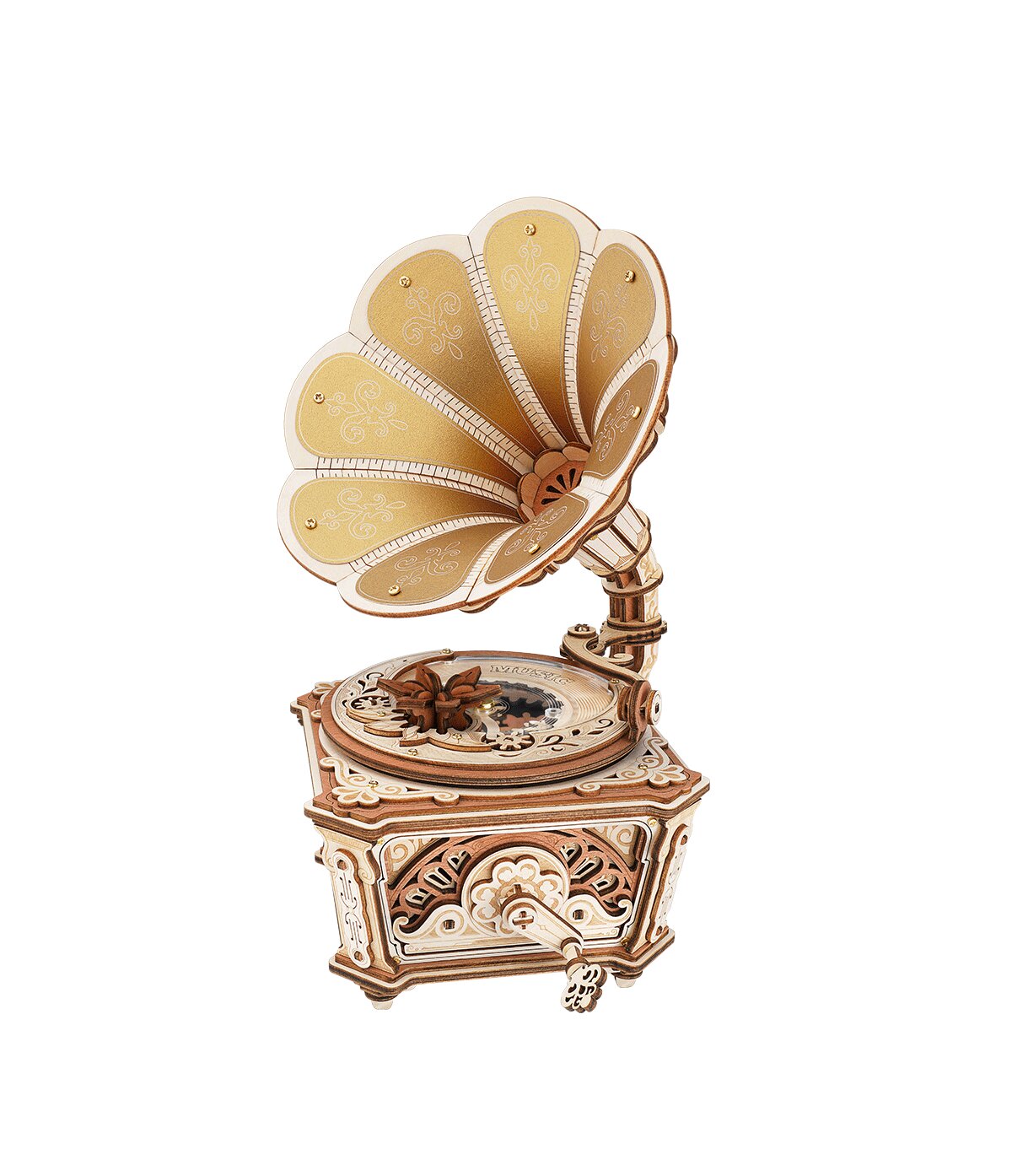
Wooden mechanical 3D puzzle - Diva turntable ROKR AMK82
- Number of pieces: 200
- Assembly time: 4.5 h
- Difficulty: 4
Frequently asked questions
What is actually stored on a record?
The shape of the groove: the waves on its walls, which the needle follows during playback. Older records have waves from side to side, while stereo records carry one channel on each groove wall.
What happens if I choose the wrong speed?
The record will not be damaged, but the music will play too fast or too slow. Check the correct speed on the record.
Does a record player play without electricity?
An old spring-driven gramophone does: the needle sets the diaphragm vibrating and the horn carries the sound. You wind the spring with a crank.
How long does a needle last?
A fixed number of hours cannot be determined, because it depends on the tracking force, the shape of the tip and cleanliness. Follow the player’s manual for the tracking force and for replacing the needle.