










A stagecoach was a public four-wheeled coach that carried paying passengers and smaller parcels on a regular route and to a timetable. It was usually drawn by four horses, sometimes six. The horses could not manage the whole journey, so the route was split into stages usually 10 to 15 miles long, about 16 to 24 km. At the end of each stage, most often at an inn, a rested team waited, that is horses harnessed together to one vehicle. From these stages the stagecoach took its English name.
Even changing horses did not make the stagecoach a fast way to travel. Until the end of the 18th century it averaged about 8 km an hour and covered roughly 100 to 110 km a day. Comfort and speed came only with better roads and with the suspension of the body where passengers sat: first on leather straps, later on steel springs. When trains began to run in the 1830s, stagecoaches gradually disappeared from the main routes. On a stagecoach model you can look at what made it a travel machine: the body suspension, the turning front axle, and the places for passengers and luggage.
Contents of the article
How the stagecoach worked: horses, wheels and suspension
The stagecoach combined three solutions without which a heavy coach full of people would not have gone far on the roads of the time: a team that both pulled and braked it, a chassis that could turn, and a suspension that softened the jolts.
- Team and pole. Horses were harnessed in pairs. The front pair led, the rear pair was closest to the coach and pulled it by the pole, a wooden bar attached to the front axle. Going downhill the rear horses leaned into a breeching strap around their rumps, linked to the pole, and so slowed the coach. American Concord stagecoaches also had wooden brake blocks that the driver pressed with a foot lever onto the iron tires of the rear wheels.
- Turning front axle. An axle is the shaft on which two wheels turn. The rear axle was fixed to the chassis; the front one turned about a vertical king-pin in the middle. Because the pole led to the front axle, the horses steered it into the new direction when turning. Front wheels were usually smaller than the rear ones so that in a turn they fitted closer under the vehicle and the coach turned in a smaller space.
- Body suspension. The body where passengers sat was not sprung at all on the oldest coaches. Later it hung on thick straps of several layers of leather that ran under its floor and were fixed to the chassis. The body swung on them forward, back and sideways and so softened the shocks from the wheels. In Roughing It (1872) Mark Twain likened the American Concord stagecoach to a cradle on wheels.
Steel springs appeared on coaches as early as the end of the 17th century, but spread only later. In 1804 the English coachbuilder Obadiah Elliott patented elliptic leaf springs, two arcs of steel strips joined at the ends. With them the body rested on springs fixed to the axles and the heavy longitudinal perch under the coach was no longer needed. On smoother English roads the springs replaced the straps. In America, where roads were often only rutted tracks, a loaded coach on bumps pressed the springs down to the chassis and they failed, so makers there stayed with straps.
| Suspension | How it holds the body | What the passenger felt | Where it lasted |
|---|---|---|---|
| no springs | body rests directly on the chassis | every wheel jolt in a pothole | oldest coaches |
| leather straps | body hangs on layered straps under the floor | swinging forward, back and sideways; a broken strap was a common fault | American Concord stagecoaches; on bad roads into the 20th century |
| steel elliptic springs | body rests on springs at the axles | a calmer ride that on a good road could also be faster | most British coaches after Elliott’s patent expired |
What a stagecoach journey was like and why it took so long
A stagecoach journey meant a full coach, a fixed timetable and stops. Inside usually sat four to six passengers; others rode on the roof and one also on the box, the raised driver’s seat at the front. Luggage went on the roof or into a boot at the rear. On British mail coaches an armed guard stood by the mail boot at the back.
Changing horses at a station was short, but passengers also stopped at inns for a meal, a drink or the night. In America, where roads were worse, people sat crowded on hard benches, and when the horses walked on hard stretches some of the journey was better done on foot beside the coach. Why the journey took so long comes down to three things:
- Pace of the horses. A team with a heavy coach averaged about 8 km an hour until the end of the 18th century. Fresh horses at the stations kept the pace, but every change and stop stretched the overall time.
- Roads. Unpaved roads with ruts slowed the coach, and in rain or frost travel was often impossible. When maintained turnpike roads and a crushed-stone surface spread in England, average speed rose from roughly 10 to 13 km an hour.
- Suspension. An unsprung coach or one hung on straps shook and swayed hard in the potholes. Stagecoach speeds rose only when better roads were joined by steel springs.
How travel gradually sped up is shown by these English routes:
| Route | Year | Journey time |
|---|---|---|
| Cambridge – London | 1750 | about 2 days |
| Cambridge – London | 1820 | less than 7 hours |
| Bristol – London, mail by riders | before 1784 | up to 38 hours |
| Bristol – London, first mail coach | 1784 | 16 hours |
| London – Liverpool, about 350 km, also overnight | 1836 | from 19.30 to 16.50 next day, average about 16 km an hour |
Why the railway replaced the stagecoach
The railway took from the stagecoach what its trade rested on: speed and the mail. Stagecoaches and mail coaches could not match the speed of trains, and the mail soon moved onto the rails. A locomotive also does not need a fresh team every few dozen kilometres.
Between Liverpool and Manchester the railway carried the mail for the first time on 11 November 1830. By the early 1840s most stagecoaches that set out from London no longer ran. Stagecoaches held on where the rails did not yet reach: in remote parts of England into the 1850s, in France in places until the arrival of buses. Across the United States they ran until the transcontinental railway was finished in 1869, and American Concord stagecoaches stayed in ordinary service into the 20th century.
So the stagecoach did not vanish at once. It retreated route by route as the rails spread. How the machine that replaced it works is in the article Steam locomotive: how steam turns wheels, what a model shows.
What to notice on a stagecoach model
A wooden stagecoach model will not show how fast it went, but it will show how it was built. What exactly your model copies you learn from its instructions and pictures. When you look it over, notice these places:
- Body suspension. Look from the side under the body for straps or spring arcs between the body and the chassis. Then gently press a finger on a corner of the body. If the body moves and returns, the model copies the springing. If it does not move, the suspension is only suggested by shape — do not press further on the body so you do not loosen the joints.
- Front axle. Slowly turn the pole or the front of the chassis sideways. If the front axle turns about the king-pin and the rear stays straight, the model steers like a real coach. Also compare wheel size: smaller front wheels fit closer under the vehicle in a turn. When the axle is stiff, stop and check the instructions whether it should turn before you force it further.
- Drive transfer. If the model has a mechanism, for example a music box, push it slowly across the table and watch which wheel or shaft turns with the mechanism. Where a gear touches a shaft, wheel motion is transferred into the mechanism. When the mechanism stands still while you move it, the wheels may be slipping on the table or something is blocking the gearing.
- Places for people and luggage. Find the box at the front, the body door, the boarding step and the boot or platform for luggage. Each of these parts matches something from a stagecoach journey: the box for the driver, the body and roof for passengers, the boot for trunks or the mail.
If the wheels or axle on a finished model turn stiffly or the mechanism jams, the steps for finding friction are in the article Sticking mechanism: how to find the friction and fix it.
You can look at these parts, for example, on the model Wooden mechanical 3D puzzle - Stagecoach ROKR AMKA1. According to the shop description it can be pulled along, steers up to 25 degrees left and right, and plays the Greensleeves melody while moving. It also has boarding steps, an opening storage box and doors. According to the shop data it is aimed at ages 14 and up.
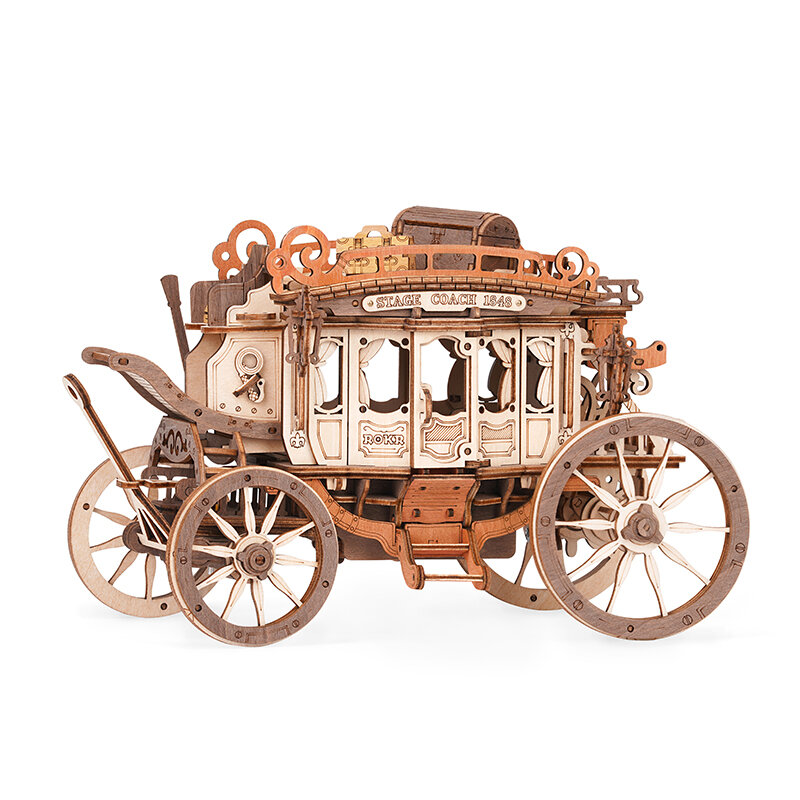
Wooden mechanical 3D puzzle - Stagecoach ROKR AMKA1
- Number of pieces: 199
- Assembly time: 4 h
- Difficulty: 3
Common questions
Why is a stagecoach called a stagecoach in English?
The journey was split into stages usually 16 to 24 km long. At the end of each stage the stagecoach got fresh horses.
How fast did a stagecoach go?
Until the end of the 18th century about 8 km an hour on average. With better roads and steel springs it sped up, and in 1836 it went from London to Liverpool at about 16 km an hour on average including horse changes.
When did stagecoaches stop running?
From the main English routes the railway pushed them out from the 1830s. Where the rails did not reach they ran for decades more; in the United States some into the 20th century.