

A steam locomotive is a boiler on wheels. The fire in the firebox, a closed furnace at the rear end of the boiler, heats water, which turns into steam. Steam under pressure flows into the cylinders on the sides of the engine and pushes a piston alternately forwards and backwards. Through the connecting rod, a long rod attached off the centre of the wheel, the piston turns the large driving wheel, much like a foot on a pedal turns the crank of a bicycle.
On a steam locomotive this motion can usually be seen from the outside: the cylinders, connecting rods and the rods that link the wheels work on the side of the engine. That is one reason it makes a rewarding prototype for models, especially when the engine has a famous story. Examples include Stephenson’s Rocket from 1829, whose solutions were taken over by almost all later steam locomotives, and the British Mallard, which in 1938 set a speed record for steam locomotives that still stands. A model shows you the shape and motion of the real engine, but its wheels are turned by your hand or a wound-up drive, not by steam.
Contents of the article
How steam turns the wheels of a locomotive
In a locomotive, steam travels one path from the fire all the way to the chimney, and a different part of the engine works on each stage of it. Once you know the order, you will find these parts on a photo of a real engine as well as on a model:
- Firebox and boiler. The fireman shovels coal into the firebox. Hot gases from the fire pass through the boiler in many tubes surrounded by water. Water also surrounds the firebox itself, so it takes heat from a large surface and turns into steam.
- Steam dome and regulator. Steam collects above the water level, often in a round housing on top of the boiler called the steam dome. Inside it is usually the regulator, a valve with which the driver lets steam to the cylinders and so controls the power of the engine.
- Cylinder and slide valve. On each side of the locomotive there is a cylinder with a piston. A sliding valve, called the slide valve, lets fresh steam alternately in front of and behind the piston and at the same time releases used steam from the other side of the piston. The piston therefore pushes in both directions, forwards and backwards.
- Crosshead and connecting rod. From the piston comes the piston rod, a rod ending in a crosshead that slides in a straight guide. The connecting rod is attached to the crosshead, and its other end sits on a crankpin off the centre of the driving wheel. This is exactly where the straight motion of the piston turns into the rotation of the wheel.
- Coupling rods. The driving wheels on one side are linked by a horizontal rod, the coupling rod. Thanks to it they all turn at once, and the power of the engine is spread over more wheels, which therefore grip the rail better.
- Exhaust and chimney. Used steam leaves the cylinders into the smokebox, the front part of the boiler under the chimney, and shoots up the chimney through a narrow blastpipe. It drags the gases from the boiler with it and so draws fresh air through the fire. The harder the locomotive works, the stronger the draught and the better the fire burns.
A locomotive with two cylinders has the cranks on the left and right sides set a quarter turn apart. When the connecting rod on one side is in line with the crankpin of the wheel, in the so-called dead centre, it cannot turn the wheel. The other side is then far from dead centre and turns the wheel, which is why the locomotive starts at any position of the wheels. For one turn of the wheel the two pistons together receive four doses of steam, and four exhaust beats come from the chimney, heard as a rhythmic chuffing.
The slide valves are driven by the valve gear, a set of rods and levers on the side of the engine between the driving wheel and the cylinder. With it the driver changes the direction of travel and sets how long fresh steam flows into the cylinder during one stroke of the piston. When starting, he lets it in for longer so that the engine has as much tractive force as possible. While running, he lets it in for a shorter time, and the rest of the work is done by the steam expanding in the cylinder. This is how the locomotive saves both coal and water.
The locomotive carries coal and water either in a tender, a separate wagon coupled right behind the driver’s cab, or, on smaller engines, in tanks directly on the locomotive. Steam from the boiler drives not only the wheels but also the whistle, the compressor for the brakes and the pump that tops up water in the boiler.
Which locomotives became model prototypes and why
Rocket, Flying Scotsman, Mallard and Albatros have all been released as models for model railways. Each made its mark on railway history through what it changed, a record or its size, and each survives in at least one example, so you can also see its prototype in real life. On top of that, you can recognise each by its shape:
| Locomotive | Year | What made it famous | How to recognise it |
|---|---|---|---|
| Rocket | 1829 | won the locomotive trials at Rainhill near Liverpool and combined a boiler with many tubes, a steam exhaust into the chimney and pistons linked by rods directly to the wheels; almost every steam locomotive then had these solutions | one pair of large driving wheels at the front, inclined cylinders on the sides and a tall chimney |
| Flying Scotsman | 1923 | on 30 November 1934 the first steam locomotive officially recorded at 100 miles per hour, about 161 km/h; today it belongs to the National Railway Museum in York | three pairs of large driving wheels linked by a coupling rod, in front of them a bogie with two axles and behind them one smaller axle |
| Mallard | 1938 | on 3 July 1938 it reached 126 miles per hour, about 203 km/h, which is still the record for steam locomotives | a smooth casing with a wedge-shaped front whose shape was tested in a wind tunnel; wheels arranged the same way as on Flying Scotsman |
| Big Boy | 1941 | 25 engines from 1941 to 1944 hauled freight trains over the mountains in the western USA; they are among the largest steam locomotives | two groups of four driving axles, each with its own cylinders, under one long boiler; the frame bends at a joint between them |
| Albatros, class 498.1 | 1954 | 15 engines from the Škoda Works in Plzeň hauled the heaviest express trains between Prague and Bratislava and later on non-electrified lines in Slovakia; engine 498.106 reached 162 km/h on 27 August 1964, the Czechoslovak record for steam locomotives | four driving axles, in front of them a bogie with two axles and behind them one axle |
The wheel arrangement is something like a signature for a locomotive. In Britain and America it is written by the number of wheels: Flying Scotsman and Mallard are both 4-6-2, that is four wheels at the front, six driving wheels and two at the rear. In continental Europe axles are counted, that is pairs of wheels. A digit means axles without drive, a capital letter driving axles (A one, B two, C three, D four), and a small prime (′) after a character says that the axles are in a bogie. Both British engines are therefore 2′C1′ and Albatros is 2′D1′. On a model you can count the axles in a few seconds and immediately know which type it resembles.
Rocket, Flying Scotsman and Mallard have been made as models for decades, and the story of each can be told in one sentence: the locomotive that set how steam locomotives would be built, the first official 100 miles per hour, the fastest steam locomotive in the world. Slovakia has its story in Albatros. Of the fifteen engines three survive, and one of them, 498.104, is in Slovakia, where it is looked after by the Albatros klub in Bratislava.
What a model shows of the real engine and what it simplifies
A wooden model shows the shape and motion of a locomotive, not its power. It has no fire and no steam, so the motion on it runs the other way: the wheels are turned by your hand or a wound-up drive, and if the piston moves, the wheels push it through the connecting rod. On a real engine the piston pushes the wheels. What exactly your model shows, you will find in its manual and pictures. When looking it over, focus on these places:
- Wheel arrangement. Count the axles at the front, the driving axles linked by a coupling rod and the axles at the rear, and compare them with the table above. When they match one of the engines, the model has the same type of running gear. When they do not, it imitates a steam locomotive more loosely.
- Connecting rod and coupling rod. Slowly turn the driving wheel and watch both rods. The coupling rod stays horizontal all the time and circles in a small circle, while the connecting rod rocks up and down. When the rods move like this, the model imitates the real motion of the engine.
- Piston and crosshead. During the same turning, watch the cylinder. If a rod with a crosshead slides out of it and back in, the model shows the conversion of straight motion into rotation. If nothing moves at the cylinder, the model shows only its shape.
- Left and right side. Stop the wheel when the connecting rod on one side is in line with the crankpin, and look at the other side. On a real two-cylinder engine the crankpin there is set a quarter turn apart. The model may or may not imitate this, and neither is a fault.
- Valve gear. Look for thinner rods and levers between the driving wheel and the upper part of the cylinder. If they move when the wheel turns, the model suggests the valve gear, which on a real engine moves the slide valve. If you cannot find them, the model has simplified or left out the valve gear.
- Boiler, dome, chimney and tender. On a model these are hollow shapes. Notice where they are: the chimney at the front, the steam dome on top of the boiler, the driver’s cab at the rear and the tender behind it. The layout matches the real engine, even though there is no water, fire or coal inside.
A real engine also had parts that are only suggested on a wooden model or missing completely: safety valves that release steam when the pressure is too high, a transparent tube on which the fireman watched the water level in the boiler, or a pump for topping up water. Without them a real boiler could not work safely; the model does not need them.
If the wheels or rods on the finished model turn stiffly or get stuck, you will find the way to track down friction in the article Sticking mechanism: how to find the friction and fix it.
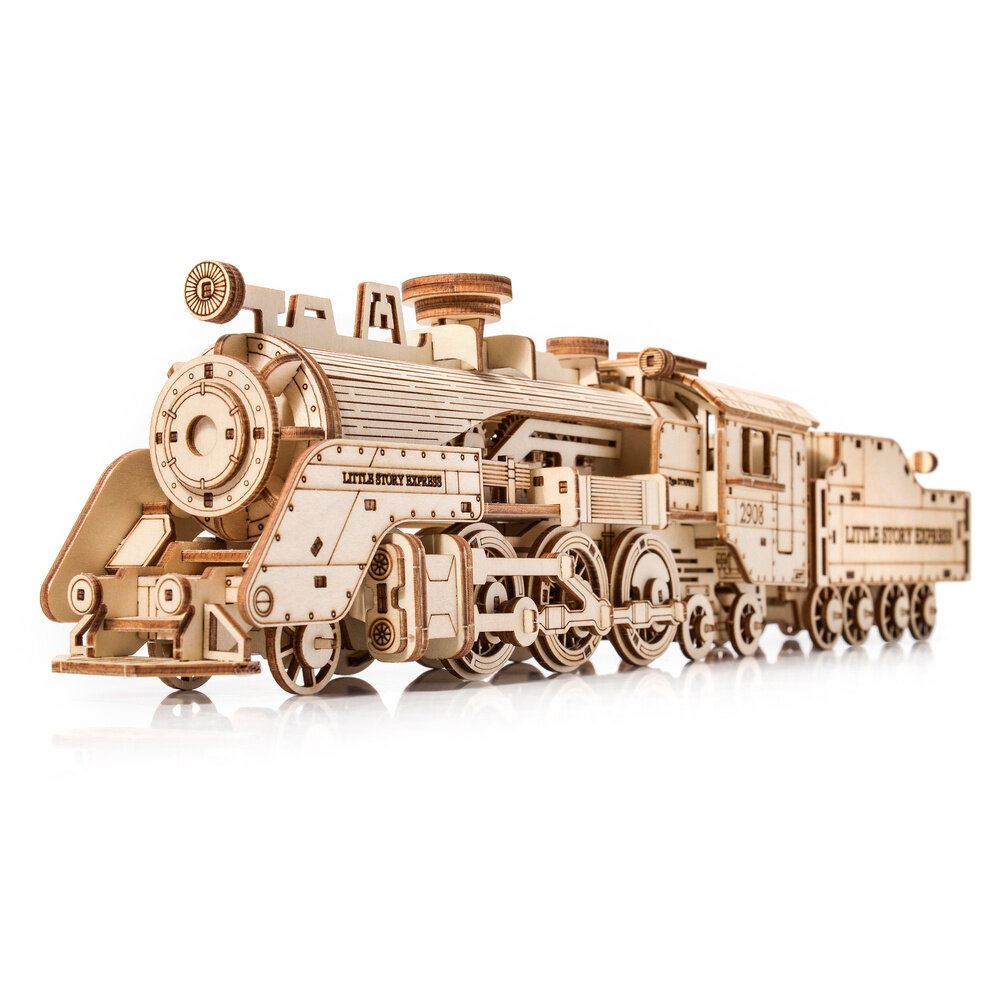
If you want to look at these parts on your own model, you can reach for the model Wooden 3D puzzle - Prime steam express train ROKR MC501, which according to the shop description has a moving piston and, once the drive is wound up, starts off under its own power; according to the shop details it is meant for ages 14 and up. According to the shop details, the model Wooden 3D puzzle - Locomotive Little Story E012 is less demanding, with a difficulty of 2 instead of 4, and also meant for ages 14 and up.
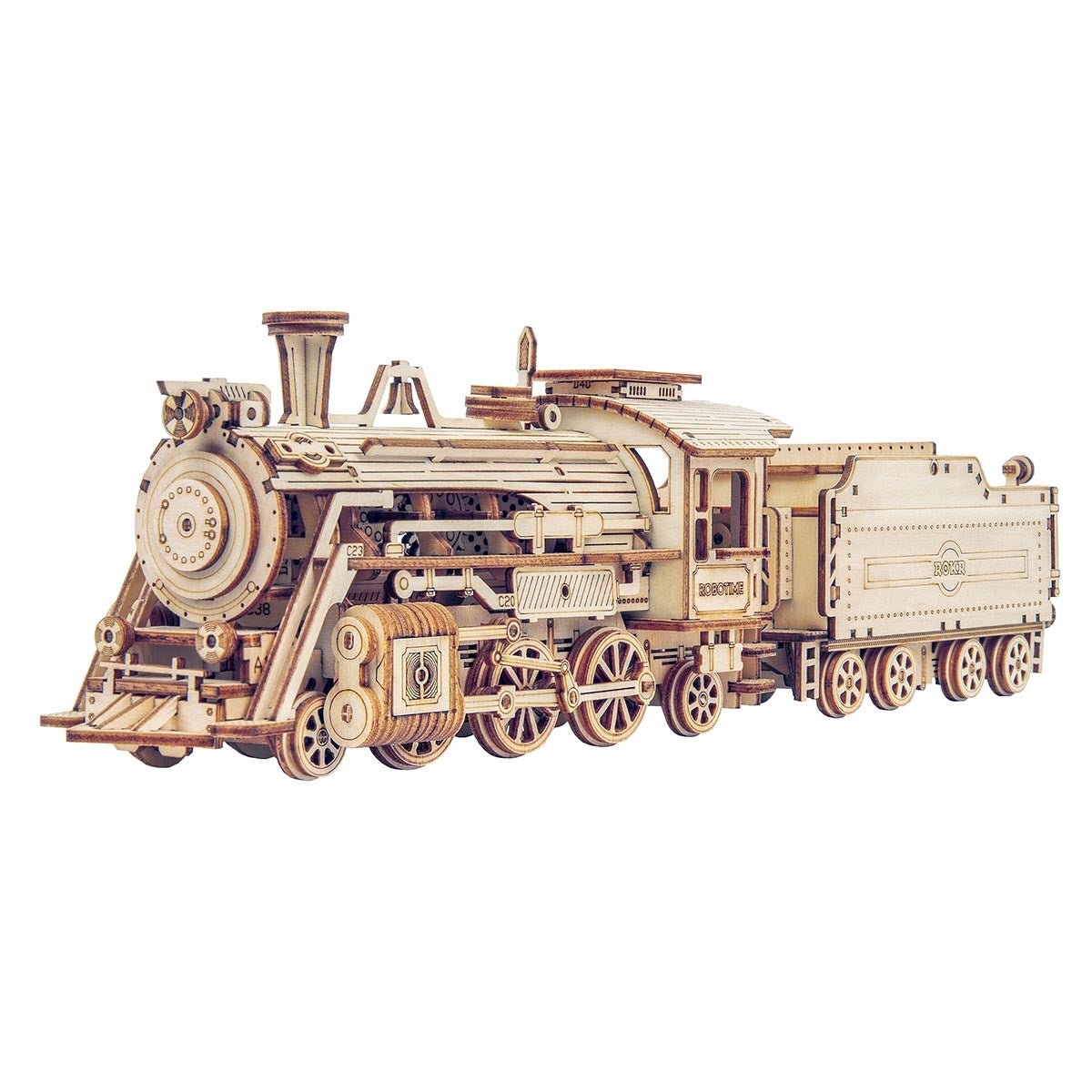
Wooden 3D puzzle - Prime steam express train ROKR MC501
- Number of pieces: 308
- Assembly time: 4 h
- Difficulty: 4
How to display the model as a piece of history
A steam locomotive model feels like a piece of history when you display it the way museums display real engines: on a track, with a short description and with the connecting rods in view. Four steps are enough:
- Identify the prototype. From the wheel arrangement and the shape of the boiler and chimney, work out which type the model resembles. If you cannot pin down a specific engine, the type and period are enough, for example an express engine with a 2′C1′ arrangement from the 1930s.
- Put it on a track. Stand the model on a short piece of track or on a narrow wooden board a little longer than the model. The base separates it from the other things on the shelf, and when dusting you lift it together with the base, without grabbing the thin rods.
- Write a card. On a small card write the type or name of the prototype, the year and one sentence about what made it famous: a record, a line or the number of engines built. The model then tells its story even to visitors who know nothing about trains.
- Set the wheels. Before displaying it, turn the driving wheels so that the connecting rod on the side facing the room stands at an angle and the piston rod is pushed out of the cylinder. In this position you can see how the rods link the piston to the wheel better than in dead centre.
If you are curious how a vehicle runs on rails when it takes current from a wire above the track instead of steam, carry on with the article The tram: where it gets power and how it runs in the city.
Frequently asked questions
How does a steam locomotive turn steam into motion?
Steam from the boiler pushes the piston in the cylinder alternately from both sides. Through the crosshead and connecting rod the piston turns the driving wheel, and the coupling rods pass the rotation on to the other driving wheels.
Why does a steam locomotive start at any position of the wheels?
The cranks on the left and right sides are set a quarter turn apart. When one side is in dead centre, the other can turn the wheel, so the locomotive starts at any position of the wheels.
Which steam locomotive was the fastest?
The British Mallard. On 3 July 1938 it reached 126 miles per hour, about 203 km/h, and this record for steam locomotives still stands. The Czechoslovak steam record is held by Albatros 498.106 with 162 km/h from 1964.
Has a famous steam locomotive survived in Slovakia?
Yes, Albatros 498.104 of class 498.1, built in the 1950s by the Škoda Works in Plzeň. It is looked after by the Albatros klub in Bratislava.