











The sails of a windmill are slightly twisted along their length, so the wind blowing at them from the front does not push them backwards but keeps turning them to the same side. The sails turn together with the shaft they are fixed to. A large gear wheel on this shaft turns a smaller wheel on an upright shaft, which carries the motion down through the mill to the millstones.
The millstones lie one on top of the other. The lower one stands still, the upper one turns above it, and the grain that falls into the hole in its centre is ground into flour in the narrow gap between them. All of this works only when the sails face straight into the wind. That is why on older mills the whole mill was turned, and on later ones only the cap with the sails.
Contents of the article
How the wind turns the sails and the motion reaches the stones
A windmill sail is a wooden lattice over which the miller stretched sailcloth, a strong fabric. Most mills have four sails. The lattice is slightly twisted along the sail, so the wind presses on the cloth at an angle and the sail always gives way in the same direction. Seen from the front, the sails of Dutch mills turn anticlockwise.
The miller adjusted the power of the mill by how much cloth he spread. In a light wind he stretched it over the whole lattice, in a strong wind he partly rolled it up, and he had to stop the mill to do so. From the end of the 18th century, sails with shutters that adjusted themselves to the strength of the wind appeared in Britain, for example the sails of William Cubitt from 1807.
From the sails, the motion travels through the mill in several steps:
- Sail shaft. The sails are fixed to an almost horizontal shaft in the head of the mill. When the sails turn, the whole shaft turns.
- Brake wheel. A large gear wheel with teeth on its side sits on the shaft. It is called the brake wheel because a brake runs around its rim: when the miller tightened it, the wheel and the sails slowed down or stopped.
- Upright shaft. The teeth of the brake wheel mesh with a smaller wheel on the upright shaft. This pair of wheels turns rotation around a horizontal axis into rotation around an upright axis, and the upright shaft carries the motion down through the floors of the mill.
- Wheel for the stones. Lower down on the upright shaft there is another large gear wheel. It meshes with small pinions, each of which drives one pair of millstones. A pinion could be moved out of mesh, so one pair of stones could stand still while the others were grinding.
- Millstones. The upper stone turns above the lower one, which does not move. The upper stone can weigh more than a tonne, and its weight is what helps to grind the grain.
In smaller mills, where all the machinery was in one wooden body that turned as a whole, the wheel on the sail shaft also drove the stones directly, without a long upright shaft. The principle is the same: gear wheels turn the rotation of the sails into the rotation of the stone.
The grain falls from above into the hole in the centre of the upper stone and gets between the stones. Grooves are cut into their faces; as the stone turns, they cut and grind the grain and move the flour towards the edge, where it comes out of the stones. The stones must not touch. The miller set the gap between them by slightly raising or lowering the upper stone: the smaller the gap, the finer the flour.
Why a mill has to face into the wind
The sails give the most power when they stand at right angles to the wind, facing straight into it. When the wind turns and blows from the side, the sails catch less of it and the mill loses power. In north-western Europe, where the wind often changes direction, every mill therefore had to have a way of turning its sails after the wind.
The first European windmills with sails turning in an upright plane appeared in the 12th century in northern France, in Flanders and in eastern England. The oldest certain mention comes from Yorkshire in England, from 1185. The first type was the post mill, and towards the end of the 13th century the mill with a fixed tower was added. The two types solve the turning differently:
| Type of mill | What turns into the wind | How the miller turned it |
|---|---|---|
| Post mill, also called the German type | the whole wooden body with the sails, wheels and stones, set on a thick wooden post | with a long beam at the back, called the tail pole |
| Tower mill, also called the Dutch type | only the cap with the shaft and sails, the tower stands fixed | with a tail pole running down from the cap, a winch, or later a fantail |
The tower of a Dutch mill does not have to turn, so it could be taller and the sails longer. Long sails high up catch more wind, and the mill works even in a lighter breeze.
In 1745 the English blacksmith Edmund Lee patented the fantail. It is a small wind wheel at the back of the cap, set at right angles to the large sails. While the wind blows at the mill from the side, the fantail spins and, through gear wheels, slowly turns the cap. It stops only when it stands parallel to the wind, and then the large sails face straight into the wind. Fantails spread mainly in England, Denmark and Germany and stayed rare elsewhere.
Both types of mill also stood in Slovakia. In Holíč, an engraving from 1801 shows a wooden mill of the German type, which turned as a whole on an oak post with the help of a tail pole. Later a three-storey stone mill of the Dutch type was built there, dating from the 1880s. Until 1926 it had a turning conical cap with sails, which was then replaced by a brick dome. It is the only surviving windmill in Slovakia.
Why windmills almost vanished from the landscape
Windmills did not disappear all at once, and no single invention pushed them out. In the 19th century many were still being built in Europe. What decided their fate were new ways of milling and new engines that could run regardless of the wind.
In the second half of the 19th century, large steam-powered mills were built. Instead of stones, metal rollers ground the grain in them in many steps one after another. This kind of milling suited hard imported wheat and gave more fine white flour, which was in growing demand. The large mills were built at ports and waterways, where the grain arrived by ship.
Small grain mills that ground for the surrounding villages lasted longer. In the Netherlands, expensive steam engines could not compete with them for a long time. They began to decline mainly when internal combustion engines and electric motors arrived, in the first decades of the 20th century. From the early 1880s to 1923, almost 30 % of the mills there disappeared.
The mill in Holíč had a similar fate: grinding stopped there after the First World War, and then it fell into disrepair for a long time. Today it is a national cultural monument.
What to look for on a model windmill
A model windmill shows the same parts as a real mill, often in a simplified form. Which of them your model has and which of them move, you will find out from its instructions and pictures. When you look it over, focus on these places:
- Type of mill. See whether the model stands on a post and turns as a whole, or has a fixed tower and a turning cap. On a tower mill, look for a tail pole or a fantail at the back of the cap.
- Sails. Count them and notice whether they have a lattice like real sails, over which the cloth was stretched. Look at them from the side: if the blades are set slightly at an angle to each other, you see the same twist that makes the sails turn in the wind.
- The place where the direction of rotation changes. Find the place where the sail shaft enters the head of the mill. If the model shows the gearing, there are two gear wheels whose axes are at right angles. Here horizontal rotation turns into upright rotation, just as at the brake wheel of a real mill.
- Upright shaft and stones. See whether the upright shaft runs down through the tower and whether the model suggests millstones. Compare how many gear wheels stand between the sails and the stones.
- Drive. On a model the motion usually does not come from the wind but, for example, from a wound-up rubber band or from turning a crank. Find out in the instructions which wheel brings the motion into the mechanism. On a real mill the power went from the sails to the stones; on a model it can go the other way, from the drive to the sails.
You can also display the finished model with its sails in a position that Dutch millers used to send messages to the neighbourhood. Sails in the shape of a cross like a plus sign meant that the mill was resting only briefly and the miller would soon carry on. Sails in the shape of the letter X meant a longer rest. Sails also announced joy and mourning, but the exact position differs from region to region.
If the sails or gear wheels on the finished model turn stiffly or get stuck, you will find how to track down the friction in the article Sticking mechanism: how to find the friction and fix it.
If you want to look at these parts on a model of your own, you can reach for the wooden model Windmill Eco Wood Art. According to the description in the shop, it has 227 pieces that fit together without glue, after assembly the sails turn thanks to a rubber band drive, and the open structure of the tower lets you look into the mechanism. According to the shop details, Windmill Eco Wood Art is intended for ages 14 and up.
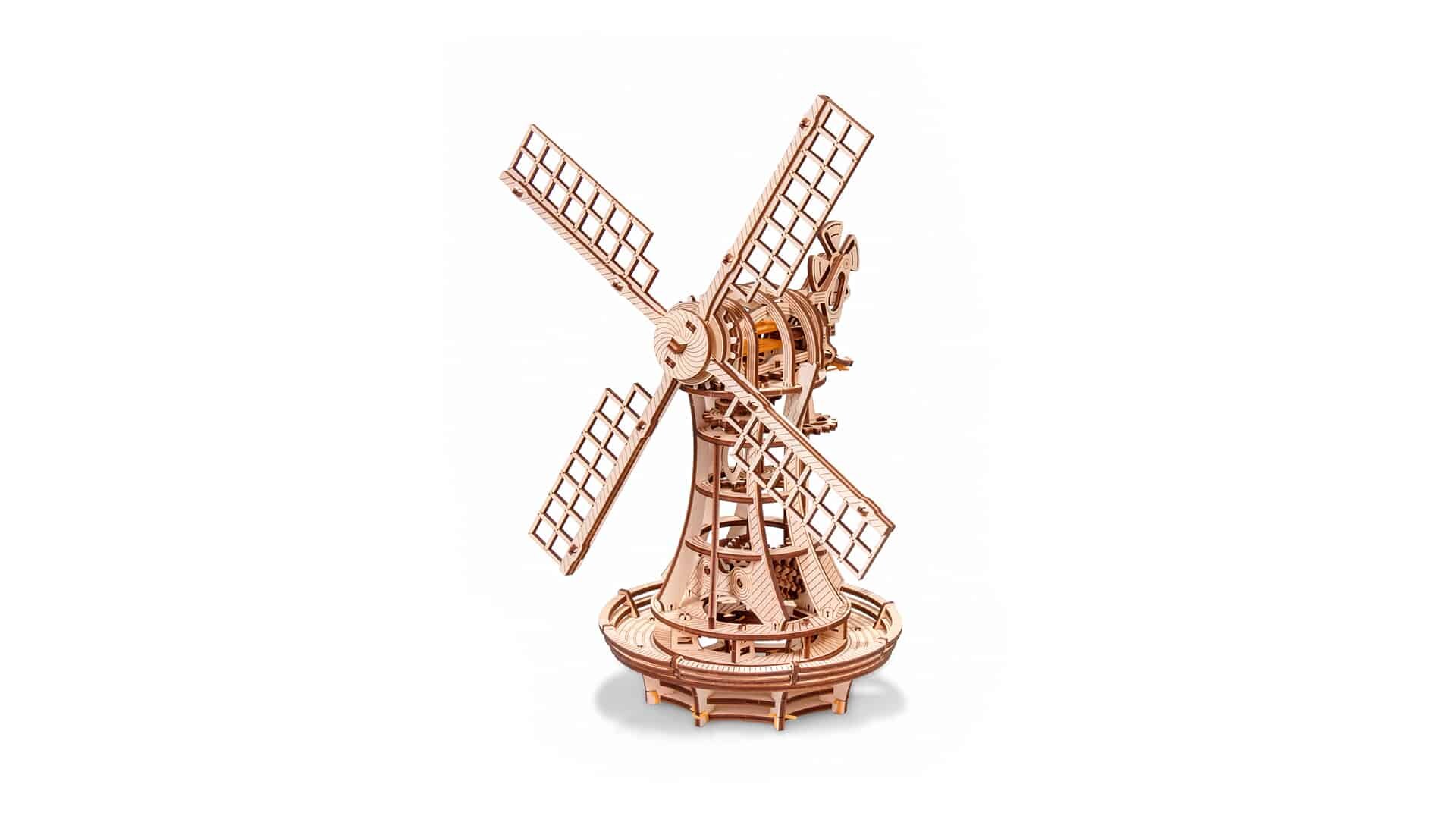
Wooden mechanical 3D puzzle - Windmill Eco Wood Art
- Number of pieces: 227
- Assembly time: 4 h
- Difficulty: 4
Frequently asked questions
Why do the sails of a windmill turn when the wind blows from the front?
Because they are slightly twisted along their length and the wind presses on them at an angle. The sail therefore always gives way to the same side and turns the shaft it is fixed to.
How does the motion of the sails reach the millstones?
The sail shaft carries a large gear wheel that turns a wheel on the upright shaft. This carries the motion down through the mill and, through further gear wheels, turns the upper millstone above the lower one, which stands still.
What is the fantail on the cap of a mill?
A small wind wheel at the back of the cap, set at right angles to the large sails. While the wind blows from the side, it spins and turns the cap until the large sails face into the wind. Edmund Lee patented it in 1745.
Is there a surviving windmill in Slovakia?
Yes, in Holíč. It is a three-storey stone mill of the Dutch type from the 1880s. Grinding stopped there after the First World War.