









A music box plays without electricity because you supply the energy. By turning the crank or the key you tension the spring, a coiled strip of steel. The spring wants to unwind and, through gear wheels, slowly turns the cylinder, which is studded with tiny pins. In front of the cylinder stands the comb: a steel plate with a row of thin teeth. A pin lifts a tooth and lets it go, the tooth starts to vibrate and one note sounds.
So the melody is written in the pins. The position of a pin along the cylinder decides which tooth sounds, and its position around the circumference decides when it sounds. The pitch of each note comes from the length and mass of the tooth, not from the speed of rotation. Turning faster or slower therefore does not change the notes, at most the tempo.
Contents of the article
What happens between turning the crank and the first note
Between turning the crank and the first note, the energy passes through several parts. You will find each of them both in an old music box and in the movement of a kit, just in a different size.
- Spring. The crank or key winds it through a ratchet. The ratchet is a small tooth that lets the motion through in one direction only, which is why you hear clicking while winding and the spring does not unwind back by itself.
- Gearing. The spring does not turn the cylinder directly. Between them are gear wheels that divide the motion so that the cylinder turns slowly and one melody lasts tens of seconds.
- Pinned cylinder. As it turns, the pins hit the teeth of the comb one after another. A pin lifts a tooth, the tooth slips off it and springs back.
- Comb. Each tooth is like a small tuning fork: once released, it vibrates at its own rate, and you hear that as a note. The vibration passes through the comb into the base and the box, which amplify the sound.
- Governor. It is a small fan with two blades that, through the gearing, turns much faster than the cylinder. The faster it turns, the more the air brakes it, and so it keeps the tempo of the melody.
Without the governor, the wound spring would release all at once. The cylinder would spin up, the pins would strike the teeth instead of gently plucking them, and the melody would blur into a short metallic sound. That is also why the music box stops when the fan stops: the whole gear train is connected and nothing moves on its own.
What decides which melody plays
Two things decide the melody: the pins on the cylinder and the tuning of the comb. The cylinder is something like sheet music rolled into a circle. Along the cylinder is the pitch, because each position faces one tooth. Around the circumference is time: pins close together mean quick notes, a bigger gap a longer pause. One turn of the cylinder usually plays the whole melody, and then it starts again.
The comb decides which notes can sound at all. Long teeth vibrate more slowly and sound low, short ones vibrate faster and sound high. For the lowest notes a tooth would have to be too long, so a small lead weight is attached under its end to slow the vibration. The number of teeth is also the number of notes the box can play: a small movement with 18 teeth plays a simple melody without chords, larger movements with more teeth can also manage an accompaniment.
The comb was not the beginning of mechanical music. Pinned cylinders had driven musical mechanisms with bells for centuries before. In 1796 the watchmaker Antoine Favre-Salomon from Geneva replaced the row of bells with a steel comb, and so music fitted into a small box. At the end of the 19th century came boxes with interchangeable metal discs, so one box could play many melodies. Later they were pushed aside by the gramophone, which records music not in pins but in a groove; how the needle reads it is described in the article Record player: how a needle turns record grooves into music.
Why the melody sounds different when you turn slower or faster
The pitch of the notes does not change when you turn slower or faster. Each tooth always vibrates at the same rate, given by its length and mass. Only how quickly the notes follow one another changes, that is, the tempo. The melody then sounds dragged out or hurried, even though it still plays the same notes. What exactly happens depends on how the crank is connected to the movement:
- The crank winds the spring. Turning faster only winds the spring sooner. The governor then holds the tempo, so the melody plays the same no matter how fast you turned.
- The crank turns the cylinder directly, without a spring and governor. Then your hand sets the tempo: slow turning stretches the melody, fast turning speeds it up.
- The spring runs down. A fully wound spring pushes harder, and more weakly as it unwinds. The governor reduces this difference, but at the end of the wind the melody may play a little slower than it did at the start.
At a very slow tempo you will notice one more thing. After being plucked, the note of a tooth gradually fades. When the next pin comes late, the previous note has already gone quiet and the melody sounds broken up. When a spring-driven box suddenly plays slower than it should, the cause is more often friction in the gearing than a weak spring.
What to look for on the model: cylinder, comb and gearing
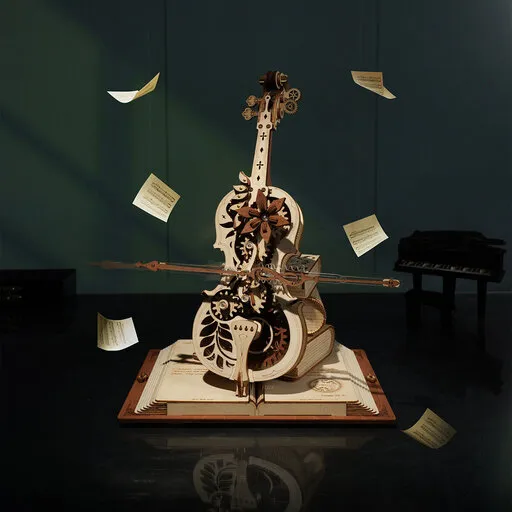
A wooden music box model usually has the music movement as a separate ready-made part that you insert into the model according to the manual. The wooden parts around it pass the motion on to figures or other moving elements. Which parts of the movement you can see and what moves while it plays differs between models, so follow the manual of your own model at every step. On the finished model, notice these places:
- Key or crank. Turn it slowly and watch the resistance. If the resistance grows and you hear the ratchet click when you let go, you are winding a spring and the governor decides the tempo. If the movement plays only while you turn, you control the tempo.
- Cylinder and comb. If the movement is visible, look from the side at the spot where the pins meet the teeth. For low notes the long teeth at one end of the comb are lifted, for high notes the short ones at the other end.
- Governor. Look for a small rotor or fan that turns the fastest of all while it plays. Do not stop it with your finger or a tool: the whole movement stops with it, and the blades are thin.
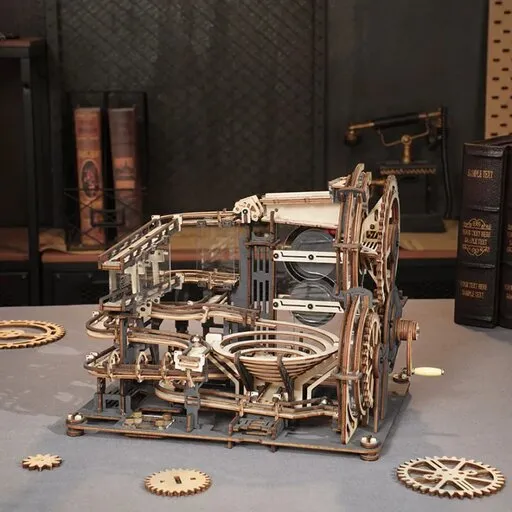
- Gearing to the figures. Follow the gear wheels that turn a figure or another moving part from the same motion. When the melody plays but the figure stands still, a wheel is not in mesh. Check in the manual which wheels should mesh before you push with force.
If the mechanism sticks or slowly stops while playing, do not look for the fault in the movement first. Most often the wooden wheels or axles around it are rubbing. How to find such a spot is described in the article Sticking mechanism: how to find the friction and fix it.
Tip: Place the finished model on a wooden table or shelf and let it play. A firm wooden base can pick up and amplify the vibration of the comb, so the melody may sound fuller than in your hand.
Models with a music movement to build

Wooden mechanical 3D puzzle - Music box starry night ROKR AMK51
- Number of pieces: 84
- Assembly time: 2 h 30 min
- Difficulty: 4

Wooden mechanical 3D puzzle - Music box magic cello ROKR AMK63
- Number of pieces: 199
- Assembly time: 4 h 30 min
- Difficulty: 4

Wooden mechanical 3D puzzle - Magic piano ROKR AMK81
- Number of pieces: 223
- Assembly time: 4 h 30 min
- Difficulty: 3
Frequently asked questions
Why does a music box play without a battery?
You supply the energy: by turning the crank or the key you tension the spring. It slowly unwinds and, through gear wheels, turns the cylinder with pins that pluck the teeth of a steel comb.
Can one box play a different melody?
On a cylinder box only if you replace the cylinder or if the cylinder carries several melodies side by side. Boxes with interchangeable metal discs play as many melodies as you have discs.
Does the note change when I turn the crank faster?
The pitch does not; it comes from the length and mass of the tooth. If the crank turns the cylinder directly, the tempo changes. If it winds a spring, the governor holds the tempo.
Why does the box play slower than before?
At the end of the wind the spring pushes more weakly, so the tempo may drop slightly. If it plays slowly even after winding, the cause is usually friction in the gearing.